Showing posts with label American Indian. Show all posts

Monday, September 14, 2015

The World Until Yesterday

The World Until Yesterday: What Can We Learn From Traditional Societies?
by Jared Diamond

Most of us take for granted the features of our modern society, from air travel and telecommunications to literacy and obesity. Yet for nearly all of its six million years of existence, human society had none of these things. While the gulf that divides us from our primitive ancestors may seem unbridgeably wide, we can glimpse much of our former lifestyle in those largely traditional societies still or recently in existence. Societies like those of the New Guinea Highlanders remind us that it was only yesterday—in evolutionary time—when everything changed and that we moderns still possess bodies and social practices often better adapted to traditional than to modern conditions.The World Until Yesterday provides a mesmerizing firsthand picture of the human past as it had been for millions of years—a past that has mostly vanished—and considers what the differences between that past and our present mean for our lives today.

This is Jared Diamond’s most personal book to date, as he draws extensively from his decades of field work in the Pacific islands, as well as evidence from Inuit, Amazonian Indians, Kalahari San people, and others. Diamond doesn’t romanticize traditional societies—after all, we are shocked by some of their practices—but he finds that their solutions to universal human problems such as child rearing, elder care, dispute resolution, risk, and physical fitness have much to teach us.

Friday, January 4, 2013

Mornings in Mexico


Mornings In Mexico
by D.H. Lawrence

Much of D.H. Lawrence's life was defined by his passion for travel and it was those wanderings that gave life to some of his greatest novels. In the 1920s Lawrence travelled several times to Mexico, where he was fascinated by the clash of beauty and brutality, purity and darkness that he observed. The diverse and evocative essays that make up Mornings in Mexico wander from an admiring portrayal of the Indian way of life to a visit to the studio of Diego Rivera and are brightly adorned with simple and evocative details: piles of fruit in a village market, strolls in a courtyard filled with hibiscus and roses, the play of light on an adobe wall. It was during his time in Mexico that Lawrence re-wrote The Plumed Serpent, which is infused with his own experiences there. To read Mornings in Mexico is thus to discover the inspiration behind of one of Lawrence's most loved works and to be immersed in a portrait of the country like no other.


Sunday, August 5, 2012

A Short Account of the Destruction of the Indies

A Short Account of the Destruction of the Indies
by Bartolomé de las Casas

An account written by the Spanish Dominican friar Bartolomé de las Casas in 1542 (published in 1552) about the mistreatment of the Indigenous Peoples of the Americas in colonial times and sent to then Prince Philip II of Spain.

One of the stated purposes for writing the account is his fear of Spain coming under divine punishment and his concern for the souls of the Native Peoples. The account is one of the first attempts by a Spanish writer of the colonial era to depict examples of unfair treatment that indigenous people endured in the early stages of the Spanish conquest of the Greater Antilles, particularly the island of La Hispaniola.

Las Casas's point of view can be described as being heavily against some of the Spanish methods of colonization, which, as he describes, have inflicted a great loss on the indigenous occupants of the islands. His account is largely responsible for the passage of the new Spanish colonial laws known as the New Laws of 1542, which abolished native slavery for the first time in European colonial history and led to the Valladolid debate. The images described by Las Casas were later depicted by Theodore de Bry in copper plate engravings that helped expand the Black Legend against Spain.

Monday, July 9, 2012

Daily Life of the Aztecs

Daily Life of the Aztecs
by Jacques Soustelle

The Aztecs were fierce, honorable, death-obsessed, and profoundly religious. A famed scholar evokes the life of this complex culture on the eve of its extinction, when the Spanish arrived and conquered them--imprisoning Montezuma and strangling Atahualpa. Vivid account of a profoundly religious warrior society — from its most primitive days to the eve of the Spanish conquest in the early 16th century. Detailed accounts of life in a city-state, religious beliefs, public buildings and markets, home furnishings, family life, the conduct of war, language, music, much more.

Sunday, January 23, 2011

Seven Myths of the Spanish Conquest

Seven Myths of the Spanish Conquest
by Matthew Restall

The notion of some final and complete "Conquest" itself becomes one of the seven examples of the misconceptions and convenient fictions examined by Restall (Latin American studies, Pennsylvania State U.) in this exploration of the Spanish invasion of the Americas. Noting that the enduring historical myths about the Conquest are rooted in cultural conceptions, misconceptions, and political agendas of the Spanish, he uses Spanish, Native American, and West African sources to contest the ideas that the Spaniards exhibited some special exceptionalism and genius, that they were agents of the King of Spain, that colonialism was rapidly imposed, that the Spaniards acted largely alone, and that the Native Americans displayed little to no adaptability and ongoing vitality in the face of the Conquest.

According to historical consensus, the Spanish conquest of the New World was a cataclysm in which superior European technology and organization overwhelmed Native American civilizations. In this daring revisionist critique, Penn State historian Restall describes a far more complex process in which Indians were central participants on both sides of the struggle. Far from regarding the Spaniards as gods, Restall argues, Indians offered a variety of shrewd, pragmatic responses to the invaders while advancing their own political agendas. Indeed, given that the conquistadors were vastly outnumbered by their Indian allies, the Conquest was in many respects a civil war between natives. Nor did Indian societies fall apart at one blow: independent Mayan polities, for example, persisted into the 19th century. Even under Spanish rule, Indians continued to live in self-governing communities, where they maintained their own languages, cultures and leaders who had considerable clout with the colonial administration. Drawing on Spanish, Native American and West African accounts of the Conquest, academic studies and even Hollywood movies, Restall examines the paradigm of European triumph and Indian "desolation" as it evolved from the conquistador's self-serving narratives to contemporary interpretations by such writers as Jared Diamond and Kirkpatrick Sale. Rejecting the implicit juxtaposition of "subhuman" Indians with "superhuman" Europeans, Restall asserts instead that, through war and epidemic, native societies retained much of their autonomy and cohesion, and "turn[ed] calamity into opportunity." Restall's provocative analysis, wide-ranging scholarship and lucid prose make this a stimulating contribution to the debate on one of history's great watersheds.

Monday, December 27, 2010

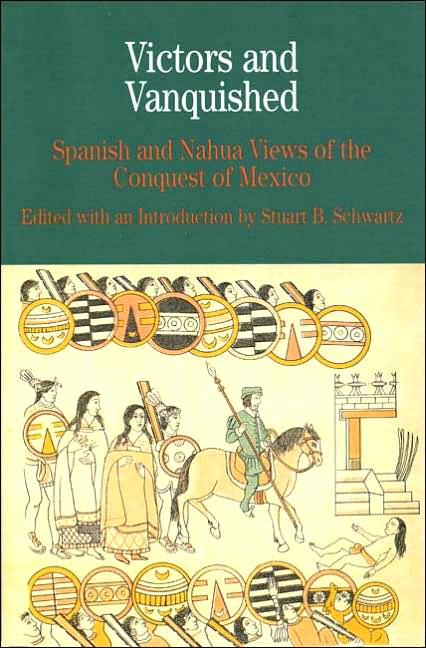
Victors and Vanquished

Victors and Vanquished: Spanish and Nahua Views of the Conquest of Mexico
edited by Stuart B. Schwartz

In 1519 Hernán Cortés and a small band of Spanish conquistadors overthrew the mighty Mexican empire of the Aztecs. Using excerpts primarily drawn from Bernal Diaz's 1632 account of the Spanish victory and testimonies — many recently uncovered — of indigenous Nahua survivors, Victors and Vanquished clearly demonstrates how personal interests, class and ethnic biases, and political considerations influenced the interpretation of momentous events. A substantial introduction is followed by 9 chronological sections that illuminate the major events and personalities in this powerful historical episode and reveal the changing attitudes toward European expansionism. The volume includes a broad array of visual images and maps, a glossary of Spanish and Nahua terms, biographical notes, a chronology, a selected bibliography, questions for consideration, and an index.

STUART B. SCHWARTZ is George Burton Adams Professor of History at Yale University. His scholary work concentrates on the early history of Latin America and the history of Brazil. He is the author of Slaves, Peasants, and Rebels: Reconsidering Brazilian Slavery (1992) and Sugar Plantations and the Formation of Brazilian Society: Bahia 1550-1835 (1985), which won the American Historical Association's Bolton Prize for the Best Work in Latin American History. Professor Schwartz is also editor of Implicit Understandings: The Encounter Between Europeans and Other Peoples in the Early Modern Era (1994) and a coeditor of The Cambridge History of Native American Peoples (1999). A former fellow of the John Simon Guggenheim Memorial Foundation, the Institute for Advanced Study, and the American Council of Learned Societies, he is currently completing a work entitled The Rebellion of Portugal and the Crisis of the Iberian Empires, 1621-1668.

Thursday, December 16, 2010

The World

The World: A History: Combined Volume
by Felipe Fernandez-Armesto

The World gives students the whole story. It is a new kind of history text – not just a collection of facts and figures. World renowned historian, world respected scholar, successful author of more than 25 books translated into 22 languages, and exceptional writer, author Felipe Fernández-Armesto offers a truly holistic narrative of the world, from human beginnings to the present. All aspects of the text – from the exceptionally clear narrative that always places the story in time, to the unparalleled map program, to the focused pedagogical features – support the story. Because of the author’s breadth of vision, students will come away with a deep understanding of the fundamental interrelationships – among peoples and their environments – that make up the world’s story.

Developing a project like The World required the input of and counsel of hundreds of individuals. David Ringrose, respected World Historian from the University of California–San Diego, served as The World’s editorial consultant, and provided extensive teaching tips in the Instructor’s Guide to Teaching the World. Nearly 100 reviewers critiqued the manuscript, from the first edition to the final draft. Instructor focus groups were held throughout the country during the publication process.

Wednesday, September 29, 2010

Freedom Just around the Corner

Freedom Just around the Corner: A New American History, 1585-1828
by Walter McDougall

The creation of the United States of America is the central event of the past four hundred years," states Walter McDougall in his preface to Freedom Just Around the Corner. With this statement begins McDougall's most ambitious, original, and uncompromising of histories. McDougall marshals the latest scholarship and writes in a style redolent with passion, pathos, and humour in pursuit of truths often obscured in books burdened with political slants.

With an insightful approach to the nearly 250 years spanning America's beginnings, McDougall offers his readers an understanding of the uniqueness of the "American character" and how this character has shaped the wide ranging course of historical events. McDougall explains that Americans have always been in a unique position of enjoying "more opportunity to pursue their ambition than any other people in history." Throughout Freedom Just Around the Corner the character of the American people shines, a character built out of a freedom to indulge in the whole panoply of human behaviour. The genius behind the success of the United States is founded on the complex, irrepressible American spirit.

A grand narrative rich with new details and insights about colonial and early national history, Freedom Just Around the Corner is the first instalment of a trilogy that will eventually bring the story of America up to the present day, a story epic, bemusing, and brooding.

Sunday, August 29, 2010

The Colonial Wars

The Colonial Wars: 1689-1762
by Howard H. Peckham

Although the colonial wars consisted of almost continuous raids and skirmishes between the English and French colonists and their Indian allies and enemies, they can be separated into four major conflicts, corresponding to four European wars of which they were, in varying degrees, a part: King William's War (1689-97) (War of the League of Augsburg); Queen Anne's War (1702-13) (War of the Spanish Succession); King George's War (1744-48) (War of the Austrian Succession); and The French and Indian War (1755-62) (Seven Years' War).

Mr. Peckham chronicles the events of these wars, summarizing the struggle for empire in America among France, England, and Spain. He indicates how the colonists applied the experience they gained from fighting Indians to their engagements with European powers. And what they learned from the colonial wars they translated into a political philosophy that led to independence and self-government.

The ready involvement of the colonies in European ambitions, the success and failure of co-operation between colony and mother country, the efforts of the English colonies together, and the growing differences between them and Britain give the narrative continuity and rising excitement.

Wednesday, August 18, 2010

The Autobiography of Benjamin Franklin

The Autobiography of Benjamin Franklin
by Benjamin Franklin

The Autobiography of Benjamin Franklin is one of the most important and influential works in American history. It tells the story of Franklin's life from his humble beginnings to his emergence as a leading figure in the American colonies. In the process, it creates a portrait of Franklin as the quintessential American. Because of the book, Franklin became a role model for future generations of Americans, who hoped to emulate his rags to riches story. The Autobiography has also become one of the central works not just for understanding Franklin but for understanding America.

Benjamin Franklin (1706-1790) was a man of many roles-printer, author, philosopher, scientist, inventor, diplomat, and politician to name only a few. He lived a wide and varied life and found himself at the center of virtually every major event involving America during the second half of the eighteenth century. He was so successful as a businessman that he was able to retire at the age of 42. He proved equally adept at science, and his experiments in electricity made him the most famous American in the colonies. Politics and diplomacy occupied him for most of the latter half of his life.

Thursday, June 17, 2010

History of the Indies

History of the Indies
by Bartolome de las Casas
translated and abridged by Andree M. Collard


This was the first english translation of Bartolome de las casas 3 volume book Historia de Las Indias;translated and edited by Andree M. Collard. This is a really important book dealing with the history of the early spanish conquest and its colonization of the indigenous people and the Americas of which has not been fully translated in its entirety.

In 1523, Las Casas joined the Dominican order and withdrew from public events for several years. His consuming task during that period was to write the History of the Indies (published posthumously), a monumental rendition of the Spanish conquest. Part history and part prophecy, Las Casas' chronicle of Spanish misdeeds was intended for future generations to be an explanation of Spain's punishment by God, which he felt certain would happen.

"Fray Bartolome de las Casas, convertiendo a una familia azteca" by Miguel Norena

Friday, May 28, 2010

Son of the Morning Star

Son of the Morning Star: Custer and the Little Bighorn
by Evan S. Connell

Custer's Last Stand is among the most enduring events in American history—more than one hundred years after the fact, books continue to be written and people continue to argue about even the most basic details surrounding the Little Bighorn. Evan S. Connell, whom Joyce Carol Oates has described as "one of our most interesting and intelligent American writers," wrote what continues to be the most reliable—and compulsively readable—account of the subject. Connell makes good use of his meticulous research and novelist's eye for the story and detail to re-vreate the heroism, foolishness, and savagery of this crucial chapter in the history of the West.

Evan S. Connell has received numerous prizes and awards for his writing and is the author of sixteen books of fiction, poetry, essays, and history, including Mr. Bridge, Mrs. Bridge, The Diary of a Rapist, The Alchymist's Journal, and The Collected Stories. He lives in Santa Fe, New Mexico.

Sunday, May 9, 2010

History Of The Second Seminole War

History Of The Second Seminole War, 1835-1842
by John K. Mahon

By the third decade of the 19th century the growing American nation had expanded so far into the Florida peninsula that in 1832 a group of Seminole tribal chiefs accepted the terms of a treaty which provided for the removal of their tribes to the West. Wiley Thompson was appointed to supervise the migration. However, a great number of the Seminoles were deeply attached to their homeland and fiercely opposed exchanging their Florida land for that promised in the West. On December 28, 1835, warriors led by Osceola massacred Thompson and a number of American citizens, thereby beginning the Second Seminole War. It continued for almost seven years and would become the most expensive of all the American Indian wars, in both monetary and human terms. After the war John T. Sprague, who had participated in the war during its last years, published "The Origin, Progress, and Conclusion of the Florida War", for 120 years the only account of this episode in US history. Drawing on data, resources and insights unavailable to Sprague, Mahon sets out to bring a broad national perspective to this study, setting the war in the context of both Florida and US military history and Indian policy.

Monday, May 3, 2010

Hunted Like a Wolf


Hunted Like a Wolf: The Story of the Seminole War
by Milton Meltzer

A landmark work for teens chronicling the Second Seminole War (1835-1842) and the treachery of the U.S. during that time. A ragged, starving handful of guerrillas, the Seminoles and blacks resisted the invading U.S. Army ten times their number. Meltzer explores the Seminoles' choices and the sacrifices they made by resisting in the longest and costliest of the Indian Wars. The book reveals America's terrible racial history, the consequences of which we are only beginning to understand.

Short film about Dade Battle

Wednesday, April 28, 2010

An Apache Campaign in the Sierra Madre

An Apache Campaign in the Sierra Madre
by John G. Bourke

An Apache Campaign in the Sierra Madre is a crackling, swift-moving narrative of General George Crook's pursuit of Geronimo and other Apache Indians across southern Arizona and New Mexico to the Sierra Madre in Mexico in 1883. The Chiricahua Apaches and their culture, the towns and landscapes, the progress of the military expedition—all are observed at first hand by General Crook's aide-de-camp, Captain John G. Bourke, who will be remembered for this and another classic, On the Border with Crook.

Friday, October 23, 2009

The Voyage of Christopher Columbus


The Voyage of Christopher Columbus: Columbus' Own Journal of Discovery Newly Restored and Translated
edited by John Cummins

The explorer's shipboard journal details his first voyage to the New World and his fateful encounter with the natives. It exists today only in a later manuscript copy by Bartolome de Las Casas, who paraphrased extensively in the third person. By restructuring this version and supplementing it with other sources, Cummins (Spanish, Univ. of Aberdeen) claims to have restored the original in a nonliteral translation that "remodels" Columbus's cumbersome Spanish. The resulting lively and highly readable narrative will have historians arguing about the authenticity of its voice. The transcription and literal translation contained in The "Diario" of Christopher Columbus's First Voyage to America (Univ. of Oklahoma Pr., 1989) remains the standard scholarly English-language edition, but general readers will enjoy Cummins's work.

Thursday, July 30, 2009

Crossing the Continent, 1527-1540

Crossing the Continent, 1527-1540: The Story of the First African-American Explorer of the American South
by Robert Goodwin

Crossing the Continent takes us on an epic journey from Africa to Europe and America as Dr. Robert Goodwin chronicles the incredible adventures of the African slave Esteban Dorantes (1500-1539), the first pioneer from the Old World to explore the entirety of the American south and the first African-born man to die in North America about whom anything is known. Goodwin's groundbreaking research in Spanish archives has led to a radical new interpretation of American history—one in which an African slave emerges as the nation's first great explorer and adventurer.

Nearly three centuries before Lewis and Clark's epic trek to the Pacific coast, Esteban and three Spanish noblemen survived shipwreck, famine, disease, and Native American hostility to make the first crossing of North America in recorded history. Drawing on contemporary accounts and long-lost records, Goodwin recounts the extraordinary story of Esteban's sixteenth-century odyssey, which began in Florida and wound through what is now Alabama, Mississippi, Louisiana, Texas, New Mexico, and Arizona, as far as the Gulf of California. Born in Africa and captured at a young age by slave traders, Esteban was serving his owner, a Spanish captain, when their disastrous sea voyage to the New World nearly claimed his life. Eventually he emerged as the leader of the few survivors of this expedition, guiding them on an extraordinary eight-year march westward to safety.

On the group's return to the Spanish imperial capital at Mexico City, the viceroy appointed Estebanas the military commander of a religious expedition sent to establish a permanent Spanish route into Arizona and New Mexico. But during this new adventure, as Esteban pushed deeper and deeper into the unknown north, Spaniards far to the south began to hear strange rumors of his death at Zuni Pueblo in New Mexico.

Filled with tales of physical endurance, natural calamities, geographical wonders, strange discoveries, and Esteban's almost mystical dealings with Native Americans, Crossing the Continent challenges the traditional telling of our nation's early history, placing an African and his relationship with the Indians he encountered at the heart of a new historical record.

Thursday, July 16, 2009

Mayflower

Mayflower: A Story of Courage, Community, and War
by Nathaniel Philbrick

From the perilous ocean crossing to the shared bounty of the first Thanksgiving, the Pilgrim settlement of New England has become enshrined as our most sacred national myth. Yet, as bestselling author Nathaniel Philbrick reveals in his spellbinding new book, the true story of the Pilgrims is much more than the well-known tale of piety and sacrifice; it is a fifty-five-year epic that is at once tragic, heroic, exhilarating, and profound.

The Mayflower's religious refugees arrived in Plymouth Harbor during a period of crisis for Native Americans as disease spread by European fishermen devastated their populations. Initially the two groups -- the Wampanoags, under the charismatic and calculating chief Massasoit, and the Pilgrims, whose pugnacious military officer Miles Standish was barely five feet tall -- maintained a fragile working relationship. But within decades, New England would erupt into King Philip's War, a savagely bloody conflict that nearly wiped out English colonists and natives alike and forever altered the face of the fledgling colonies and the country that would grow from them.

With towering figures like William Bradford and the distinctly American hero Benjamin Church at the center of his narrative, Philbrick has fashioned a fresh and compelling portrait of the dawn of American history-a history dominated right from the start by issues of race, violence, and religion.

For sixty-five days, the Mayflower had blundered her way through storms and headwinds, her bottom a shaggy pelt of seaweed and barnacles, her leaky decks spewing salt walter onto her passengers' devoted heads. There were 102 of them -- 104 if you counted the two dogs: a spaniel and a giant, slobbery mastiff . . . . They were a most unusual group of colonists. Instead of noblemen, craftsmen, and servants -- the types of people who had founded Jamestown in Virginia -- these were, for the most part, families: men, women, and children who were willing to endure almost anything if it meant they could worship as they pleased . . . .

It was a stunningly audacious proposition. With the exception of Jamestown, all other attempts to establish a permanent English settlement on the North American continent had so far failed. And Jamestown, founded in 1607, could hardly be counted a success . . . . Between 1619 and 1622, the Virginia Company would send close to 3,600 settlers to the colony; over that three-year period, 3,000 would die.

In addition to starvation and disease, there was the threat of Indian attack. At the university library in Leiden [the town in Holland where the Puritans had lived] were sensational accounts left by earlier explorers and settlers, telling how the Indians "delight to torment men in the most bloody manner that may be; flaying some alive with the shells of fishes, cutting off the members and joints of others by piecemeal and broiling on the coals." How could parents willingly subject their children to the risk of such a fate?

In the end, all arguments for and against emigrating to America ended with the conviction that God wanted them to go.

Sunday, June 28, 2009

Big Chief Elizabeth

Big Chief Elizabeth: The Adventures and Fate of the First English Colonists in America
by Giles Milton

In April 1586, Queen Elizabeth I acquired a new and exotic title. A tribe of Native Americans had made her their weroanza—a word that meant "big chief". The news was received with great joy, both by the Queen and her favorite, Sir Walter Ralegh. His first American expedition had brought back a captive, Manteo, who caused a sensation in Elizabethan London. In 1587, Manteo was returned to his homeland as Lord and Governor, with more than one hundred English men, women, and children. In 1590, a supply ship arrived at the colony to discover that the settlers had vanished.

For almost twenty years the fate of Ralegh's colonists was to remain a mystery. When a new wave of settlers sailed to America to found Jamestown, their efforts to locate the lost colony were frustrated by the mighty chieftain, Powhatan, father of , who vowed to drive the English out of America. Only when it was too late did the settlers discover the incredible news that Ralegh's colonists had survived in the forests for almost two decades before being slaughtered in cold blood by henchmen. While Sir Walter Ralegh's "savage" had played a pivotal role in establishing the first English settlement in America, he had also unwittingly contributed to one of the earliest chapters in the decimation of the Native American population. The mystery of what happened to these colonists who seemed to vanish without a trace lies at the heart of this well-researched work of narrative history.

Saturday, January 24, 2009

The Indians of California

The American Indians: The Indians of California
edited by Time-Life Books

Stories of the vastly diverse peoples of the area now known as California and their interactions with Europeans and gold-diggers are told in admirable detail, often through first-person accounts. Rarely seen, superb archival photographs are abundant throughout, and there are full-color photo essays on the land, types of houses, the White Deerskin Dance of the Hupa people, basketry, mission artwork, the blending of Christian and native religions, the Cupeno struggle for their homeland, and the tragic story of Ishi. An outstanding overview of a complex region, supported by an up-to-date bibliography and thorough index.