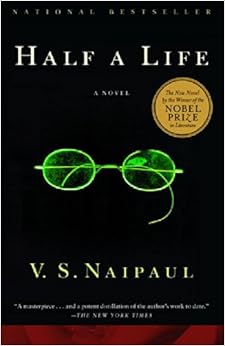
Half A Life
by V.S. Naipaul
Willie Somerset Chandran is the son of a Brahmin father and a Dalit mother. His father gave him his middle name as a homage to the English writer Somerset Maugham who had visited the father in the temple where the father was living under a vow of silence. Having come to despise his father, Willie leaves India to go to 1950s London to study. There he leads a life as a poor immigrant and later he writes a book of short stories and manages to publish it.
Willie receives a letter from Ana, a mixed Portuguese and black African girl, who admires his book, and they arrange to meet. They fall in love and Willie follows her to her country (an unnamed Portuguese colony in Africa, presumably Mozambique). Meanwhile Willie's sister Sarojini marries a German and moves to Berlin. The novel ends with Willie having moved to his sister's place in Berlin after his 18 year stay in Africa.
Half a Life is a precursor to Naipaul's 2004 novel Magic Seeds which starts with Willie in Berlin.
Showing posts with label V. S. Naipaul. Show all posts
Wednesday, June 24, 2015
Tuesday, December 4, 2012
A Bend in the River
A Bend in the River
by V.S. Naipaul
by V.S. Naipaul
A Bend in the River is the story of Salim, an Indian born and raised on the east coast of Africa. He buys a shop in a river town in the interior, in the aftermath of a post-colonial rebellion. The novel tells the story of Salim’s slow rise and fall in business, alongside the story of the town’s slow rise and fall. The town’s fortunes, along with those of Salim and the rest of the characters in the town, slowly scrape toward prosperity after the rebellion. A president’s interest creates a boon, and then paranoia and rebellion and destruction. Fortunes rise and fall, again and again.
Salim offers a fascinating perspective. I’ve read books voiced by Africans about Africa, and books voiced by Westerners about Africa, but Salim is an Indian writing about Africa—the citizen of one colony living in another colony, and writing about post-colonial life. Author Naipaul shared this perspective, being of Indian descent but born and raised in Trinidad. Throughout the book, Salim remains an outsider, an observer to the conflicts and customs of Africa. The other characters that he befriends are also outsiders—his house-servant Metty, a boy-turned-man without a tribe named Ferdinand, fellow Indian merchants Mahesh and Shoba, childhood friend from a wealthier background Indar, and Brits Raymond and Yvette. All of them live in this African world without being of it. They appreciate it in different ways, and their own fortunes are tied up in this town at the bend in the river, or in the political powers at work.
Saturday, October 31, 2009
Miguel Street
by V. S. Naipaul
The novel presents a series of separate episodes of childhood experienced by an unnamed narrator, all happening in and around Miguel Street, a street in western Port of Spain. The book contains a number of idiosyncratic characters, including Mr. Popo, the carpenter who never finishes making anything and is always working on the thing without a name; the poet B. Wordsworth (taking his last name from English Romantic poet William Wordsworth) who is working on the greatest poem ever written but has never written past the first line; and Man-Man, the mad man who becomes a prophet. The book is the story of great ambitions that never went anywhere and are only left for the narrator to remember and record. The narrator himself is part of a group of kids on the street who get into various adventures in the neighborhood. Only the narrator manages, by the end of the story, to escape from Miguel Street and leave Trinidad, with the hope of making something of himself.The story is written primarily in the first person, with each character getting his or her own chapter; the narrator's experiences are woven in-between, except for the last two or three chapters, which are primarily about the narrator himself.
Labels:
Caribbean,
Novels,
Trinidad and Tobago,
V. S. Naipaul
Subscribe to:
Posts (Atom)
