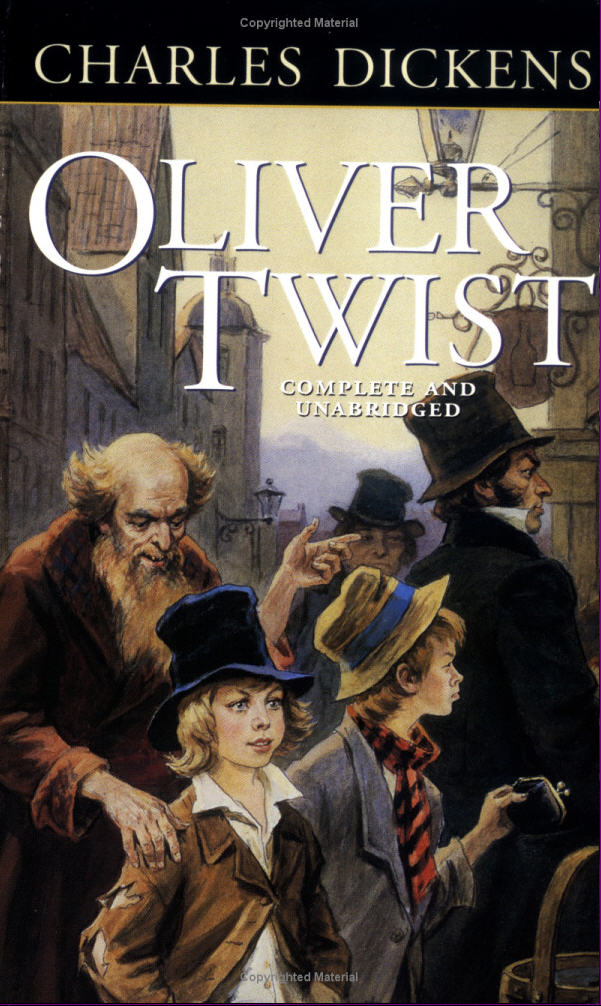
Oliver Twist, or The Parish Boy's Progress
by Charles Dickens
Oliver Twist, or The Parish Boy's Progress, is the second novel by Charles Dickens, and was first published as a serial 1837–9. The story is of the orphan Oliver Twist, who starts his life in a workhouse and is then sold into an apprenticeship with an undertaker. He escapes from there and travels to London where he meets the Artful Dodger, a member of a gang of juvenile pickpockets, which is led by the elderly criminal Fagin.
Oliver Twist is notable for Dickens's unromantic portrayal of criminals and their sordid lives, as well as exposing the cruel treatment of the many orphans in London in the mid–nineteenth century. The alternate title, The Parish Boy's Progress, alludes to Bunyan's The Pilgrim's Progress, as well as the 18th-century caricature series by William Hogarth, A Rake's Progress and A Harlot's Progress.
An early example of the social novel, Dickens satirizes the hypocrisies of his time, including child labour, the recruitment of children as criminals, and the presence of street children. The novel may have been inspired by the story of Robert Blincoe, an orphan whose account of working as a child labourer in a cotton mill was widely read in the 1830s. It is likely that Dickens's own youthful experiences contributed as well.
Showing posts with label England. Show all posts
Sunday, February 21, 2016
Wednesday, June 24, 2015
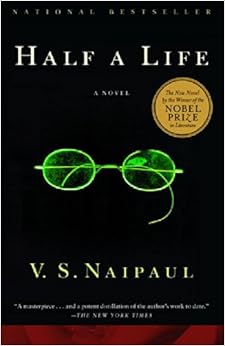
Half A Life
Half A Life
by V.S. Naipaul
Willie Somerset Chandran is the son of a Brahmin father and a Dalit mother. His father gave him his middle name as a homage to the English writer Somerset Maugham who had visited the father in the temple where the father was living under a vow of silence. Having come to despise his father, Willie leaves India to go to 1950s London to study. There he leads a life as a poor immigrant and later he writes a book of short stories and manages to publish it.
Willie receives a letter from Ana, a mixed Portuguese and black African girl, who admires his book, and they arrange to meet. They fall in love and Willie follows her to her country (an unnamed Portuguese colony in Africa, presumably Mozambique). Meanwhile Willie's sister Sarojini marries a German and moves to Berlin. The novel ends with Willie having moved to his sister's place in Berlin after his 18 year stay in Africa.
Half a Life is a precursor to Naipaul's 2004 novel Magic Seeds which starts with Willie in Berlin.
by V.S. Naipaul
Willie Somerset Chandran is the son of a Brahmin father and a Dalit mother. His father gave him his middle name as a homage to the English writer Somerset Maugham who had visited the father in the temple where the father was living under a vow of silence. Having come to despise his father, Willie leaves India to go to 1950s London to study. There he leads a life as a poor immigrant and later he writes a book of short stories and manages to publish it.
Willie receives a letter from Ana, a mixed Portuguese and black African girl, who admires his book, and they arrange to meet. They fall in love and Willie follows her to her country (an unnamed Portuguese colony in Africa, presumably Mozambique). Meanwhile Willie's sister Sarojini marries a German and moves to Berlin. The novel ends with Willie having moved to his sister's place in Berlin after his 18 year stay in Africa.
Half a Life is a precursor to Naipaul's 2004 novel Magic Seeds which starts with Willie in Berlin.
Labels:
Africa,
England,
India,
Novels,
V. S. Naipaul
Monday, December 19, 2011
Rights of Man, Part II
Rights of Man, Part IIby Thomas Paine
Rights of Man presents an impassioned defense of the Enlightenment principles of freedom and equality that Thomas Paine believed would soon sweep the world. He boldly claimed, "From a small spark, kindled in America, a flame has arisen, not to be extinguished. Without consuming ... it winds its progress from nation to nation." Though many more sophisticated thinkers argued for the same principles and many people died in the attempt to realize them, no one was better able than Paine to articulate them in a way which fired the hopes and dreams of the common man and actually stirred him to revolutionary political action.
Tuesday, December 13, 2011
Vindication of the Rights of Woman
A Vindication of the Rights of Woman: with Strictures on Political and Moral Subjectsby Mary Wollstonecraft
A Vindication of the Rights of Woman: with Strictures on Political and Moral Subjects (1792), written by the 18th-century British feminist Mary Wollstonecraft, is one of the earliest works of feminist philosophy. In it, Wollstonecraft responds to those educational and political theorists of the 18th century who did not believe women should have an education. She argues that women ought to have an education commensurate with their position in society, claiming that women are essential to the nation because they educate its children and because they could be "companions" to their husbands, rather than mere wives. Instead of viewing women as ornaments to society or property to be traded in marriage, Wollstonecraft maintains that they are human beings deserving of the same fundamental rights as men.
Wollstonecraft was prompted to write the Rights of Woman after reading Charles Maurice de Talleyrand-Périgord's 1791 report to the French National Assembly, which stated that women should only receive a domestic education; she used her commentary on this specific event to launch a broad attack against sexual double standards and to indict men for encouraging women to indulge in excessive emotion. Wollstonecraft wrote the Rights of Woman hurriedly in order to respond directly to ongoing events; she intended to write a more thoughtful second volume but died before completing it.
While Wollstonecraft does call for equality between the sexes in particular areas of life, such as morality, she does not explicitly state that men and women are equal. Her ambiguous statements regarding the equality of the sexes have since made it difficult to classify Wollstonecraft as a modern feminist, particularly since the word and the concept were unavailable to her. Although it is commonly assumed now that the Rights of Woman was unfavourably received, this is a modern misconception based on the belief that Wollstonecraft was as reviled during her lifetime as she became after the publication of William Godwin's Memoirs of the Author of A Vindication of the Rights of Woman (1798). The Rights of Woman was actually well-received when it was first published in 1792. One biographer has called it "perhaps the most original book of [Wollstonecraft's] century".
Labels:
England,
Europe,
Mary Wollstonecraft,
Women's Studies
Saturday, December 10, 2011
A Vindication of the Rights of Men
"A Vindication of the Rights of Men"
by Mary Wollstonecraft
A Vindication of the Rights of Men, in a Letter to the Right Honourable Edmund Burke; Occasioned by His Reflections on the Revolution in France (1790) is a political pamphlet, written by the 18th-century British feminist Mary Wollstonecraft, which attacks aristocracy and advocates republicanism. Wollstonecraft's was the first response in a pamphlet war sparked by the publication of Edmund Burke's Reflections on the Revolution in France (1790), a defence of constitutional monarchy, aristocracy, and the Church of England.
Wollstonecraft attacked not only hereditary privilege, but also the rhetoric that Burke used to defend it. Most of Burke's detractors deplored what they viewed as his theatrical pity for Marie Antoinette, but Wollstonecraft was unique in her love of Burke's gendered language. By saying the sublime and the beautiful, terms first established by Burke himself in A Philosophical Enquiry into the Origin of Our Ideas of the Sublime and Beautiful (1756), she kept his rhetoric as well as his argument. In her first abashedly feminist critique, which Wollstonecraft scholar Claudia Johnson describes as unsurpassed in its argumentative force Wollstonecraft indicts Burke's justification of an equal society founded on the passivity of women.
In her arguments for republican virtue, Wollstonecraft invokes an emerging middle-class ethos in opposition to what she views as the vice-ridden aristocratic code of manners. Driven by an Enlightenment belief in progress, she derides Burke for relying on tradition and custom. She describes an idyllic country life in which each family has a farm sufficient for its needs. Wollstonecraft contrasts her utopian picture of society, drawn with what she claims is genuine feeling, with Burke's false theatrical tableaux.
The Rights of Men was successful: it was reviewed by every major periodical of the day and the first edition sold out in three weeks. However, upon the publication of the second edition (the first to carry Wollstonecraft's name on the title page), the reviews began to evaluate the text not only as a political pamphlet but also as the work of a female writer. They contrasted Wollstonecraft's "passion" with Burke's "reason" and spoke condescendingly of the text and its female author. This analysis of the Rights of Men prevailed until the 1970s, when feminist scholars began to read Wollstonecraft's texts with more care and called attention to their intellectualism.
by Mary Wollstonecraft
A Vindication of the Rights of Men, in a Letter to the Right Honourable Edmund Burke; Occasioned by His Reflections on the Revolution in France (1790) is a political pamphlet, written by the 18th-century British feminist Mary Wollstonecraft, which attacks aristocracy and advocates republicanism. Wollstonecraft's was the first response in a pamphlet war sparked by the publication of Edmund Burke's Reflections on the Revolution in France (1790), a defence of constitutional monarchy, aristocracy, and the Church of England.
Wollstonecraft attacked not only hereditary privilege, but also the rhetoric that Burke used to defend it. Most of Burke's detractors deplored what they viewed as his theatrical pity for Marie Antoinette, but Wollstonecraft was unique in her love of Burke's gendered language. By saying the sublime and the beautiful, terms first established by Burke himself in A Philosophical Enquiry into the Origin of Our Ideas of the Sublime and Beautiful (1756), she kept his rhetoric as well as his argument. In her first abashedly feminist critique, which Wollstonecraft scholar Claudia Johnson describes as unsurpassed in its argumentative force Wollstonecraft indicts Burke's justification of an equal society founded on the passivity of women.
In her arguments for republican virtue, Wollstonecraft invokes an emerging middle-class ethos in opposition to what she views as the vice-ridden aristocratic code of manners. Driven by an Enlightenment belief in progress, she derides Burke for relying on tradition and custom. She describes an idyllic country life in which each family has a farm sufficient for its needs. Wollstonecraft contrasts her utopian picture of society, drawn with what she claims is genuine feeling, with Burke's false theatrical tableaux.
The Rights of Men was successful: it was reviewed by every major periodical of the day and the first edition sold out in three weeks. However, upon the publication of the second edition (the first to carry Wollstonecraft's name on the title page), the reviews began to evaluate the text not only as a political pamphlet but also as the work of a female writer. They contrasted Wollstonecraft's "passion" with Burke's "reason" and spoke condescendingly of the text and its female author. This analysis of the Rights of Men prevailed until the 1970s, when feminist scholars began to read Wollstonecraft's texts with more care and called attention to their intellectualism.
Tuesday, December 6, 2011
Reflections on the Revolution in France
Reflections on the Revolution in Franceby Edmund Burke
Burke's seminal work was written during the early months of the French Revolution, and it predicted with uncanny accuracy many of its worst excesses, including the Reign of Terror. A scathing attack on the revolution's attitudes to existing institutions, property and religion, it makes a cogent case for upholding inherited rights and established customs, argues for piecemeal reform rather than revolutionary change - and deplores the influence Burke feared the revolution might have in Britain. "Reflections on the Revolution in France" is now widely regarded as a classic statement of conservative political thought, and is one of the eighteenth century's great works of political rhetoric.
Labels:
Edmund Burke,
England,
France,
History,
Politics,
Revolution
Saturday, November 19, 2011
"A Discourse on the Love of our Country"
by Richard Price
Richard Price (1723–1791) was a Unitarian minister in London and a writer on moral philosophy, population, and the national debt, among other topics. The British statesman and political theorist Edmund Burke singled out Price's Discourse on the Love of Our Country (1789), delivered a scant two and a half months after the Fall of the Bastille, for attack in his antirevolutionary Reflections on the Revolution in France (1790), which inaugurated a protracted and violent debate in England between those who favored and those who opposed the French Revolution. The full title of Price's address is A Discourse on the Love of Our Country, Delivered on Nov. 4, 1789, at the Meeting-House in the Old Jewry, to the Society for Commemorating the Revolution in Great Britain. The "Revolution" being commemorated — the subject of the first two-thirds of the extracts given here — is the "bloodless" Glorious Revolution of 1688, which ended the short reign of James II. In the final third, beginning "What an eventful period is this!" Price greets with religious fervor "two other Revolutions" — that is, the American and the French revolutions.
Richard Price was a British moral philosopher and preacher in the tradition of English Dissenters, and a political pamphleteer, active in radical, republican, and liberal causes such as the American Revolution. He fostered connections between a large number of people, including writers of the Constitution of the United States. He spent most of his adult life as minister of Newington Green Unitarian Church, where possibly the congregant he most influenced was early feminist Mary Wollstonecraft, who extended his ideas on the egalitarianism inherent in the spirit of the French Revolution to encompass women's rights as well. In addition to his work as a moral and political philosopher, he also wrote on issues of statistics and finance, and was inducted into the Royal Society for these contributions.
by Richard Price
Richard Price (1723–1791) was a Unitarian minister in London and a writer on moral philosophy, population, and the national debt, among other topics. The British statesman and political theorist Edmund Burke singled out Price's Discourse on the Love of Our Country (1789), delivered a scant two and a half months after the Fall of the Bastille, for attack in his antirevolutionary Reflections on the Revolution in France (1790), which inaugurated a protracted and violent debate in England between those who favored and those who opposed the French Revolution. The full title of Price's address is A Discourse on the Love of Our Country, Delivered on Nov. 4, 1789, at the Meeting-House in the Old Jewry, to the Society for Commemorating the Revolution in Great Britain. The "Revolution" being commemorated — the subject of the first two-thirds of the extracts given here — is the "bloodless" Glorious Revolution of 1688, which ended the short reign of James II. In the final third, beginning "What an eventful period is this!" Price greets with religious fervor "two other Revolutions" — that is, the American and the French revolutions.
Richard Price was a British moral philosopher and preacher in the tradition of English Dissenters, and a political pamphleteer, active in radical, republican, and liberal causes such as the American Revolution. He fostered connections between a large number of people, including writers of the Constitution of the United States. He spent most of his adult life as minister of Newington Green Unitarian Church, where possibly the congregant he most influenced was early feminist Mary Wollstonecraft, who extended his ideas on the egalitarianism inherent in the spirit of the French Revolution to encompass women's rights as well. In addition to his work as a moral and political philosopher, he also wrote on issues of statistics and finance, and was inducted into the Royal Society for these contributions.
Thursday, November 17, 2011
The Making of the English Working Class
The Making of the English Working Classby E. P. Thompson
The Making of the English Working Class is an influential and pivotal work of English social history, written by E. P. Thompson, a notable 'New Left' historian; it was published in 1963 (revised 1968) by Victor Gollancz Ltd, and later republished at Pelican, becoming an early Open University Set Book. It concentrates on English artisan and working class society "in its formative years 1780 to 1832."
Its tone is captured by the oft-quoted line from the preface:
"I am seeking to rescue the poor stockinger, the Luddite cropper, the "obsolete" hand-loom weaver, the "utopian" artisan, and even the deluded follower of Joanna Southcott, from the enormous condescension of posterity." (Thompson, 1980: 12)
Thompson attempts to add a humanist element to social history, being critical of those who turn the people of the working class into an inhuman statistical bloc. These people were not just the victims of history: Thompson displays them as being in control of their own making. He also discusses the popular movements that are oft forgotten in history, such as obscure Jacobin societies like the London Corresponding Society. Thompson makes great effort to recreate the life-experience of the working class(es), which is what often marks it out as such an extremely influential work.
Thompson uses the term "working class" rather than "classes" throughout, to emphasize the growth of a working-class consciousness. He claims in the Preface that "in the years between 1780 and 1832 most English working people came to feel an identity of interests as between themselves, and as against other men whose interests are different from (and usually opposed to) theirs."
Thompson's re-evaluation of the Luddite movement, and his (unsympathetic) treatment of the influence of the early Methodist movement on working class aspirations are also particularly memorable. (Thompson's parents were Methodist missionaries.)
Thompson's theories on working-class consciousness are at the core of this writing, and their agency was manifested by way of the core English working-class values of solidarity, collectivism, mutuality, political radicalism and Methodism. Thompson wished to disassociate Marxism from Stalinism and his injection of humanistic principles in this book was his way of steering the Left toward democratic socialism as opposed to totalitarianism.
Labels:
England,
EP Thompson,
Europe,
History,
Socialism
Monday, October 24, 2011
The Modern Middle East: A Reader
Edited by Albert Habib Hourani, Philip Shukry Khoury, Mary Christina Wilson
This valuable collection of essays brings leading Middle Eastern scholars together in one volume and provides an unparalleled view of the modern Middle East. Covering two centuries of change, from 1789 to the present, the selection is carefully designed for students and is the only available text of its kind. It will also appeal to anyone with a general interest in the Middle East.
The book is divided into four sections: Reforming Elites and Changing Relations with Europe, 1789-1918; Transformations in Society and Economy, 1789-1918; The Construction of Nationalist Ideologies and Politics up to the 1950s; and The Middle East since the Second World War.
Includes Roger Owen's case study that argues that much of what happened in Egypt in the 19th century is well accounted for in the theories of Marx, Hobson, Luxemburg, Hilferding and Baran. But there are three areas where the theories do not provide and adequate framework: the role of the metropolitan states in relation to their capitalists, the nature of the Egyptian state and the changes in the Egyptian social structure with imperial penetration produced.
Edited by Albert Habib Hourani, Philip Shukry Khoury, Mary Christina Wilson
This valuable collection of essays brings leading Middle Eastern scholars together in one volume and provides an unparalleled view of the modern Middle East. Covering two centuries of change, from 1789 to the present, the selection is carefully designed for students and is the only available text of its kind. It will also appeal to anyone with a general interest in the Middle East.
The book is divided into four sections: Reforming Elites and Changing Relations with Europe, 1789-1918; Transformations in Society and Economy, 1789-1918; The Construction of Nationalist Ideologies and Politics up to the 1950s; and The Middle East since the Second World War.
Includes Roger Owen's case study that argues that much of what happened in Egypt in the 19th century is well accounted for in the theories of Marx, Hobson, Luxemburg, Hilferding and Baran. But there are three areas where the theories do not provide and adequate framework: the role of the metropolitan states in relation to their capitalists, the nature of the Egyptian state and the changes in the Egyptian social structure with imperial penetration produced.
Labels:
Africa,
Economics,
Egypt,
England,
Essays,
History,
Islam,
Jewish History,
Middle East
Sunday, August 28, 2011
Military Revolution
The Military Revolution: Military Innovation and the Rise of the West, 1500-1800 by Geoffrey Parker
Well before the Industrial Revolution, Europe developed the superior military potential and expertise that enabled her to dominate the world for the next two centuries. In this attractively illustrated and updated edition, Geoffrey Parker discusses the major changes in the military practice of the West during this time period—establishment of bigger armies, creation of superior warships, the role of firearms—and argues that these major changes amounted to a "military revolution" that gave Westerners a decided advantage over people of other continents.
Monday, August 22, 2011
Leviathan
Leviathan, Or The Matter, Forme and Power of a Commonwealth Ecclesiastical and Civilby Thomas Hobbes
Leviathan, Hobbes's most important work and one of the most influential philosophical texts produced during the seventeenth century, was written partly as a response to the fear Hobbes experienced during the political turmoil of the English Civil Wars. In the 1640s, it was clear to Hobbes that Parliament was going to turn against King Charles I, so he fled to France for eleven years, terrified that, as a Royalist, he would be persecuted for his support of the king. Hobbes composed Leviathan while in France, brilliantly articulating the philosophy of political and natural science that he had been developing since the 1630s. Hobbes's masterwork was finally published in 1651, two years after Parliament ordered the beheading of Charles I and took over administration of the English nation in the name of the Commonwealth.
Leviathan's argument for the necessity of absolute sovereignty emerged in the politically unstable years after the Civil Wars, and its publication coincided with that of many Republican treatises seeking to justify the regicide (killing of the king) to the rest of Europe (John Milton's Tenure of Kings and Magistrates is a famous example of these regicide tracts). Not only was the political argument of Leviathan controversial at the time of its publication, but the philosophical method employed by Hobbes to make his claims also scandalized many of his contemporaries--even those writers, such as Robert Filmer (the author of the Royalist tract Patriarcha), who otherwise supported Hobbes's claims for absolute sovereignty.
Hobbes's materialist philosophy was based upon a mechanistic view of the universe, holding that all phenomena were explainable purely in terms of matter and motion, and rejecting concepts such as incorporeal spirits or disembodied souls. Consequently, many critics labeled Hobbes an atheist (although he was not, in the strict sense). Associated with both atheism and the many deliberately terrifying images of Leviathan, Hobbes became known as the "Monster of Malmsbury" and the "Bug-bear of the Nation." In 1666, Hobbes's books were burned at Oxford (where Hobbes had graduated from Magdalen College in 1608), and the resulting conflagration was even blamed in Parliament for having started the Great Fire of London. The chaotic atmosphere of England in the aftermath of the Civil Wars ensured that Hobbes's daring propositions met with a lively reaction.
Hobbes knew that Leviathan would be controversial, for not only did the text advocate restoration of monarchy when the English republic was at its strongest (Oliver Cromwell was not instituted as Lord High Protector until 1653, and the Restoration of Charles II did not occur until 1660), but Hobbes's book also challenged the very basis of philosophical and political knowledge. Hobbes claimed that traditional philosophy had never arrived at irrefutable conclusions, that it had instead offered only useless sophistries and insubstantial rhetoric; he thus called for a reform of philosophy that would enable secure truth--claims with which everyone could agree.
Consequently, Hobbesian philosophy would prevent disagreements about the fundamental aspects of human nature, society, and proper government. Furthermore, because Hobbes believed that civil war resulted from disagreements in the philosophical foundations of political knowledge, his plan for a reformed philosophy to end divisiveness would also end the conditions of war. For Hobbes, civil war was the ultimate terror, the definition of fear itself. He thus wanted to reform philosophy in order to reform the nation and thereby vanquish fear.
Earlier in the seventeenth century, Francis Bacon--for whom Hobbes had served as secretary in his youth--had also proposed a reform of philosophy, a reform he called the "Great Instauration." Bacon's program was an inductive philosophy based upon the observation of natural facts ("inductive" reasoning derives general principles from particular instances or facts); the experimental manipulation of nature of Bacon's scheme was very influential for the development of the historical period commonly called the Scientific Revolution, and also formed the backbone of the English Royal Society. Like Hobbes's, Bacon's system rejected traditional philosophical knowledge as untrustworthy, instead embracing nature as the only sure basis for all claims for truth. But Hobbes argued that the experimentalist program was also unsuccessful in providing secure, indisputable knowledge. Hobbes therefore rejected the Baconian system and argued vehemently against it. Hobbes's own deductive scientific philosophy was not experimental--in "deductive" reasoning, a conclusion follows necessarily from the stated premises, rather than being inferred from instances of these premises--but Hobbes maintained that it provided better understanding of the universe and society than both traditional philosophy and experimental science.
Leviathan attempted to create controversy in politics and in science, radically challenging both contemporary government and philosophy itself; yet, despite its very invocation of controversy, Leviathan sought ultimately to annihilate controversy for good. Hobbes's philosophical method claimed to provide indisputable conclusions, and its depiction of the Leviathan of society suggested that the Hobbesian method could put an end to controversy, war, and fear. Hobbes's philosophy was highly influential in certain sectors (Hobbesism was a fashionable intellectual position well into the eighteenth century). However, Hobbes, who died in 1679, never lived to see his work achieve the widespread and totalizing effects for which he had hoped. Excluded from the Royal Society for his anti-experimentalist stance and derided by many contemporaries as an immoral monster, Hobbes neither transformed the nation nor reformed philosophy as he had envisioned. Nonetheless, Hobbes has had a lasting influence in the history of Western philosophy, as he is credited with inaugurating political science; his crowning achievement, Leviathan is still recognized as one of the greatest masterpieces of the history of ideas. Written during a moment in English history when the political structure, social structure, and methods of science were all in flux and open to manipulation, Leviathan played an essential role in the development of the modern world.
Leviathan is divided into four books: "Of Man," "Of Common-wealth," "Of a Christian Common-wealth," and "Of the Kingdome of Darknesse." Book I contains the philosophical framework for the entire text, while the remaining books simply extend and elaborate the arguments presented in the initial chapters. Consequently, Book I is given the most attention in the detailed summaries that follow. Hobbes begins his text by considering the elementary motions of matter, arguing that every aspect of human nature can be deduced from materialist principles. Hobbes depicts the natural condition of mankind--known as the state of nature--as inherently violent and awash with fear. The state of nature is the "war of every man against every man," in which people constantly seek to destroy one another. This state is so horrible that human beings naturally seek peace, and the best way to achieve peace is to construct the Leviathan through social contract.
Book II details the process of erecting the Leviathan, outlines the rights of sovereigns and subjects, and imagines the legislative and civil mechanics of the commonwealth. Book III concerns the compatibility of Christian doctrine with Hobbesian philosophy and the religious system of the Leviathan. Book IV engages in debunking false religious beliefs and arguing that the political implementation of the Leviathanic state is necessary to achieve a secure Christian commonwealth.
Hobbes's philosophical method in Leviathan is modeled after a geometric proof, founded upon first principles and established definitions, and in which each step of argument makes conclusions based upon the previous step. Hobbes decided to create a philosophical method similar to the geometric proof after meeting Galileo on his extended travels in Europe during the 1630s. Observing that the conclusions derived by geometry are indisputable because each of constituent steps is indisputable in itself, Hobbes attempted to work out a similarly irrefutable philosophy in his writing of Leviathan.
Monday, August 15, 2011
Seventeenth-Century Europe
Seventeenth-Century Europeby Thomas Munck
This is a fully-revised edition of a well-established synthesis of the period from the Thirty Years War to the consolidation of absolute monarchy and the landowning society of the ancient régime. Thematically organized, the book covers all of Europe, from Britain and Scandinavia to Spain and Eastern Europe. Important new material has been added on the Ottomans, on Christian-Muslem contacts and on the role of women, and the text has been thoroughly updated to take account of recent research.
Thomas Munck is Reader in History at the University of Glasgow.
Thursday, August 4, 2011
The Power of Kings
The Power of Kings: Monarchy and Religion in Europe, 1589-1715by Paul Kleber Monod
In the sixteenth century, the kings of Europe were like gods to their subjects. Within 150 years, however, this view of monarchs had altered dramatically: a king was the human, visible sign of the rational state. How did such a momentous shift in political understanding come about? This sweeping book explores the changing cultural significance of the power of European kings from the assassination of France's Henry III to the death of Louis XIV. Paul Kléber Monod draws on political history, political philosophy, anthropology, sociology, and literature to understand the relationship between kings and their political subjects and the interplay between monarchy and religion. He also makes use of 35 paintings and statues to illuminate the changing public images of kings.
Discussing monarchies throughout Europe, from Britain to Russia, Monod tells how sixteenth-century kings and queens were thought to heal the sick with a touch, were mediators between divine authority and the Christian self in quasi-religious ceremonies, and were seen as ideal mirrors of human identity. By 1715, the sacred authority of the monarchy had been supplanted by an ideology fusing internal moral responsibility with external obedience to an abstract political authority. Subjects were expected to identify not with a sacred king but with the natural person of the ruler. No longer divine, the kings and queens of the Enlightenment took up a new, more human place in the hearts and minds of their subjects.
Thursday, July 7, 2011
"The Agrarian Roots of European Capitalism"
"The Agrarian Roots of European Capitalism"by Robert Brenner
from The Brenner Debate: Agrarian Class Structure and Economic Development in Preindustrial Europe
"In what follows, I will take up each of the foregoing objections in
the course of presenting a more fully developed interpretation of
the problems of European feudal evolution and of the transition to
capitalism. In Section I, I will attempt, once again, to lay bare what
I believe to be the faulty foundations upon which the demographic
interpretation has been constructed. In Section II, I will try to
sketch a general approach to long-term feudal socio-economic evolution,
and then to demonstrate that this approach can better grasp
the actual course of medieval economic development, income distribution
and feudal crisis in the different European regions than
can either the demographic interpretation or Bois's "falling rate of
feudal levy" approach. Finally, in Section III, I will, in direct
response to the criticisms that have been raised, lay out what I take
to be the origins of the different property systems which emerged in different regions of Europe during the early modern period, and
explain why these property systems were in fact central in determining
the subsequent paths of economic development."
from Introduction
Sunday, July 3, 2011
"Agrarian Class Structure and Economic Development in Pre-industrial Europe"
"Agrarian Class Structure and Economic Development in Pre-industrial Europe" by Robert Brenner
from The Brenner Debate: Agrarian Class Structure and Economic Development in Preindustrial Europe
Robert P. Brenner is a professor of history and director of the Center for Social Theory and Comparative History at UCLA, editor of the socialist journal Against the Current, and editorial committee member of New Left Review. His research interests are Early Modern European History; economic, social and religious history; agrarian history; social theory/Marxism; and Tudor-Stuart England.
He has been one of the contributors in a major Marxist debate, "Transition from Feudalism to Capitalism". In this debate he has sided on the importance of the transformation of agricultural production in Europe, especially in the English countryside, as opposed to the rise of international trade as the main cause of the transition. His influential 1976 article on "Agrarian Class Structure and Economic Development in Pre-industrial Europe" set forth the controversial "Brenner thesis." He argued that smallholding peasants had strong property rights and had little incentive to give up traditional technology or go beyond local markets, and thus no incentive toward capitalism
Thursday, March 24, 2011
Black Folk Here and There, Vol. 2
Black Folk Here and There : An Essay in History and Anthropology, Volume II
by St. Clair Drake
To the Jews of pre-Christian Palestine, Black people were sometimes friends and sometimes enemies, but never objects of racially based derision or contempt. The ancient Greeks categorized people not as Black or white, but as ''civilized'' or ''uncivilized.'' In the Muslim world, many slaves were Blacks, but so were many soldiers, several prominent rulers, and an occasional saint. Armed with such facts gathered during a lifetime of research, St. Clair Drake in his final work, Black Folk Here and There, submits to the test of history a wide range of theories that attempt to explain what happens when Black people and white people interact and why color prejudice may arise.
In this volume, Drake challenges theories claiming that negative attitudes toward blackness and Black people, which emerged from centuries of racial slavery, have always prevailed. Drake finds telling evidence of color prejudice and equally telling evidence of its absence or irrelevance.
by St. Clair Drake
To the Jews of pre-Christian Palestine, Black people were sometimes friends and sometimes enemies, but never objects of racially based derision or contempt. The ancient Greeks categorized people not as Black or white, but as ''civilized'' or ''uncivilized.'' In the Muslim world, many slaves were Blacks, but so were many soldiers, several prominent rulers, and an occasional saint. Armed with such facts gathered during a lifetime of research, St. Clair Drake in his final work, Black Folk Here and There, submits to the test of history a wide range of theories that attempt to explain what happens when Black people and white people interact and why color prejudice may arise.
In this volume, Drake challenges theories claiming that negative attitudes toward blackness and Black people, which emerged from centuries of racial slavery, have always prevailed. Drake finds telling evidence of color prejudice and equally telling evidence of its absence or irrelevance.
Labels:
Africa,
Black Experience,
England,
Europe,
Islam,
Jewish History,
Spain
Wednesday, September 29, 2010
Freedom Just around the Corner
by Walter McDougall
With an insightful approach to the nearly 250 years spanning America's beginnings, McDougall offers his readers an understanding of the uniqueness of the "American character" and how this character has shaped the wide ranging course of historical events. McDougall explains that Americans have always been in a unique position of enjoying "more opportunity to pursue their ambition than any other people in history." Throughout Freedom Just Around the Corner the character of the American people shines, a character built out of a freedom to indulge in the whole panoply of human behaviour. The genius behind the success of the United States is founded on the complex, irrepressible American spirit.
A grand narrative rich with new details and insights about colonial and early national history, Freedom Just Around the Corner is the first instalment of a trilogy that will eventually bring the story of America up to the present day, a story epic, bemusing, and brooding.
Labels:
American Indian,
Benjamin Franklin,
Colonial,
England,
France,
George Washington,
History,
Spain,
Thomas Jefferson,
USA,
War
Sunday, August 29, 2010
The Colonial Wars
by Howard H. Peckham
Although the colonial wars consisted of almost continuous raids and skirmishes between the English and French colonists and their Indian allies and enemies, they can be separated into four major conflicts, corresponding to four European wars of which they were, in varying degrees, a part: King William's War (1689-97) (War of the League of Augsburg); Queen Anne's War (1702-13) (War of the Spanish Succession); King George's War (1744-48) (War of the Austrian Succession); and The French and Indian War (1755-62) (Seven Years' War).
Mr. Peckham chronicles the events of these wars, summarizing the struggle for empire in America among France, England, and Spain. He indicates how the colonists applied the experience they gained from fighting Indians to their engagements with European powers. And what they learned from the colonial wars they translated into a political philosophy that led to independence and self-government.
The ready involvement of the colonies in European ambitions, the success and failure of co-operation between colony and mother country, the efforts of the English colonies together, and the growing differences between them and Britain give the narrative continuity and rising excitement.
Wednesday, August 18, 2010
The Autobiography of Benjamin Franklin
by Benjamin Franklin
Benjamin Franklin (1706-1790) was a man of many roles-printer, author, philosopher, scientist, inventor, diplomat, and politician to name only a few. He lived a wide and varied life and found himself at the center of virtually every major event involving America during the second half of the eighteenth century. He was so successful as a businessman that he was able to retire at the age of 42. He proved equally adept at science, and his experiments in electricity made him the most famous American in the colonies. Politics and diplomacy occupied him for most of the latter half of his life.
Labels:
American Indian,
Autobiography,
Benjamin Franklin,
Colonial,
England,
History,
Philosophy,
USA
Monday, July 19, 2010
The Decline and Fall of the Roman Empire, Volume I
by Edward Gibbon
Gibbon’s masterpiece, which narrates the history of the Roman Empire from the second century a.d. to its collapse in the west in the fifth century and in the east in the fifteenth century, is widely considered the greatest work of history ever written. This first volume covers the last two hundred years of the Roman Empire leading up to its collapse.
Subscribe to:
Posts (Atom)