Showing posts with label Abraham Lincoln. Show all posts

Sunday, July 14, 2013

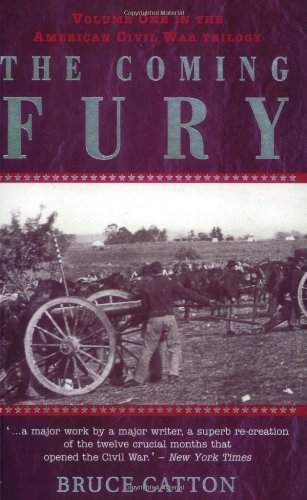
The Coming Fury

The Centennial History of the Civil War, Part 1: The Coming Fury
by Bruce Catton

 This one is about the complex legal issues that led to the Civil War and to the most momentous decision in U. S. history: how should President Lincoln respond to the secessions and the seizures of federal property in the South? It raises many interesting questions, not the least of which is, did he make the right decision? Was the bloodbath worth it? If Lincoln had known the consequences, would he have made the same decision? If he had let the South go, would it have brought peace? How long would slavery have continued?

Was secession a Constitutional right, as the Confererates claimed? If not, why did Lincoln recognize West Virginia’s right to secede from Virginia? Was this a hypocritical double standard? Private property was protected by the Constitution; did that include private property in slaves? Lincoln thought it did. Was he justified in suspending habeas corpus in Maryland? What is a nation? Is it a compact among sovereign states? Or is it a sovereignty over constituent states? When federals violated the Fugitive Slave Law, did that constitute recognition that the South was an independent country? 

Thursday, January 17, 2013

Hallowed Ground

Hallowed Ground: A Walk at Gettysburg
by James M. McPherson

“[I]n a larger sense, we can not dedicate—we can not consecrate—we can not hallow—this ground. The brave men, living and dead, who struggled here, have consecrated it, far above our power to add or detract.”
—President Abraham Lincoln

James M. McPherson, the Pulitzer Prize–winning author of Battle Cry of Freedom, and arguably the finest Civil War historian in the world, walks us through the site of the bloodiest and perhaps most consequential battle ever fought by Americans. 

The events that occurred at Gettysburg are etched into our collective memory, as they served to change the course of the Civil War and with it the course of history. More than any other place in the United States, Gettysburg is indeed hallowed ground. It’s no surprise that it is one of the nation’s most visited sites (nearly two million annual visitors), attracting tourists, military buffs, and students of American history. 

McPherson, who has led countless tours of Gettysburg over the years, makes stops at Seminary Ridge, the Peach Orchard, Cemetery Hill, and Little Round Top, among other key locations. He reflects on the meaning of the battle, describes the events of those terrible three days in July 1863, and places the struggle in the greater context of American and world history. Along the way, he intersperses stories of his own encounters with the place over several decades, as well as debunking several popular myths about the battle itself.

What brought those 165,000 soldiers—75,000 Confederate, 90,000 Union—to Gettysburg? Why did they lock themselves in such a death grip across these once bucolic fields until 11,000 of them were killed or mortally wounded, another 29,000 were wounded and survived, and about 10,000 were “missing”—mostly captured? What was accomplished by all of this carnage? Join James M. McPherson on a walk across this hallowed ground as he be encompasses the depth of meaning and historical impact of a place that helped define the nation’s character.

Thursday, April 21, 2011

The American Intellectual Tradition: Volume I

The American Intellectual Tradition: Volume I: 1630-1865
edited by David A. Hollinger and Charles Capper

Revised and updated, the fifth edition of this now standard two-volume anthology brings together some of the most historically significant writings in American intellectual history. Uniquely comprehensive, The American Intellectual Tradition includes classic works in philosophy, religion, social theory, political thought, economics, psychology, and cultural and literary criticism. Organized chronologically into thematic sections, the two volumes trace the evolution of intellectual writing and thinking from its origins in Puritan beliefs to the most recent essays on diversity and postmodernity. Pedagogical features include introductions and headnotes to the selections, updated bibliographic material throughout, and detailed chronologies at the end of each book. Addressing such highly contested subjects as race, class, gender, aesthetics, political religion, and the role of the United States in the world, The American Intellectual Tradition, Fifth Edition, is invaluable for undergraduate courses in intellectual history. It is also an excellent supplement for graduate seminars and classes in American history, American studies, and American literature.

Volumes I and II now offer new selections from Roger Williams, John Humphrey Noyes, Asa Gray, Thomas Wentworth Higginson, Charles Augustus Briggs, Elizabeth Cady Stanton, Walter Lippmann, Thurman Arnold, Henry Luce, Henry A. Wallace, Albert Einstein, Aldo Leopold, James Baldwin, George Kennan, Milton Friedman, Herbert Marcuse, Edward Said, Gloria Anzaldua, Henry Louis Gates, Jr., Joan W. Scott, Samuel Huntington, and Carl Sagan.

Friday, August 6, 2010

Inhuman Bondage

Inhuman Bondage: The Rise and Fall of Slavery in the New World
by David Brion Davis

Winner of a Pulitzer Prize and a National Book Award, David Brion Davis has long been recognized as the leading authority on slavery in the Western World. Now, in Inhuman Bondage, Davis sums up a lifetime of insight in this definitive account of New World slavery.

The heart of the book looks at slavery in the American South, describing black slaveholding planters, the rise of the Cotton Kingdom, the daily life of ordinary slaves, the highly destructive slave trade, the sexual exploitation of slaves, the emergence of an African-American culture, and much more. But though centered on the United States, the book offers a global perspective spanning four continents. It is the only study of American slavery that reaches back to ancient foundations and also traces the long evolution of anti-black racism in European thought. Equally important, it combines the subjects of slavery and abolitionism as very few books do, and it connects the actual life of slaves with the crucial place of slavery in American politics, stressing that slavery was integral to America's success as a nation—not a marginal enterprise.

A definitive history by a writer deeply immersed in the subject, Inhuman Bondage offers a compelling portrait of the dark side of the American dream.

Tuesday, April 27, 2010

The Civil War: A Narrative, Vol. 3

The Civil War: A Narrative: Volume 3: Red River to Appomattox
by Shelby Foote

Considered one of the definitive Civil War narratives as well as one of the 20th-century's greatest works of nonfiction, this third volume of a three-volume history presents the true events, the battles, and biographies of significant figures on both sides of the conflict.

Thursday, March 4, 2010

The Civil War: A Narrative, Vol. 2

The Civil War: A Narrative, Fredericksburg to Meridian
by Shelby Foote

"Gettysburg...is described with such meticulous attention to action, terrain, time, and the characters of the various commanders that I understand, at last, what happened in that battle.... Mr. Foote has an acute sense of the relative importance of events and a novelist's skill in directing the reader's attention to the men and the episodes that will influence the course of the whole war, without omitting items which are of momentary interest. His organization of facts could hardly be better." —Atlantic

"Though the events of this middle year of the Civil War have been recounted hundreds of times, they have rarely been re-created with such vigor and such picturesque detail." —The New York Times Book Review

"The lucidity of the battle narratives, the vigor of the prose, the strong feeling for the men from generals to privates who did the fighting, are all controlled by constant sense of how it happened and what it was all about. Foote has the novelist's feeling for character and situation, without losing the historian's scrupulous regard for recorded fact. The Civil War is likely to stand unequaled." —Walter Mills

Saturday, January 9, 2010

American Legacy

American Legacy: The United States Constitution and Other Essential Documents of American Democracy

American Legacy is an 80-page booklet that comprises the U.S. Constitution and the Declaration of Independence together with passages from other documents that encompass essential ideas of American democracy. The documents are arranged chronologically beginning with the Mayflower Compact.


Included are excerpts from such documents as:
  • The Federalist
  • Chief Justice John Marshall's decision in Marbury v. Madison
  • George Washington's "Farewell Address"
  • Thomas Jefferson's first inaugural address
  • Sojourner Truth's "Ain't I a Woman?"
  • Abraham Lincoln's first inaugural address
  • The Gettysburg Address
  • The Emancipation Proclamation
  • Learned Hand's "The Spirit of Liberty"
  • Martin Luther King, Jr.'s "I Have a Dream"
  • The Civil Rights Act of 1964

Sunday, December 27, 2009

The Civil War, A Narrative: Fort Sumter to Perryville


The Civil War, A Narrative: Fort Sumter to Perryville
by Shelby Foote

The Civil War: A Narrative (1958-1974) is a three volume, 2,968-page, 1.2 million-word history of the American Civil War by Shelby Foote. Although previously known as a novelist, Foote is most famous for this non-fictional narrative history. While it touches on political and social themes, the main thrust of the work is military history.

The first volume covers the roots of the war to the Battle of Perryville on October 8, 1862. All the significant battles are here, from Bull Run through Shiloh, the Seven Days Battles, Second Bull Run to Antietam, and Perryville in the fall of 1862, but so are the smaller and often equally important engagements on both land and sea: Ball's Bluff, Fort Donelson, Pea Ridge, Island No. Ten, New Orleans, Monitor versus Merrimac, and Stonewall Jackson's Valley Campaign.

Saturday, September 26, 2009

The Civil War and Reconstruction

The Civil War and Reconstruction: A Documentary Collection
Edited by William E. Gienapp

An ample, wide-ranging collection of primary sources, The Civil War and
Reconstruction: A Documentary Collection
, opens a window onto the
political, social, cultural, economic, and military history from 1830
to 1877. Particular attention is paid to social history; coverage of
the experience of African Americans, women, and non-elites provides a
well-rounded picture of the period. Substantial selections, careful
editing, and helpful annotations make this collection an ideal
supplement for your course on the Civil War and Reconstruction.

This text contains selected reproductions of primary-source documents on the Civil War and Reconstruction period edited for student use. The documents, drawn from the period 1830-1877, discuss social and economic developments as well as political, military, and diplomatic events. Letters and diary entries provide information on people's private lives. A sampling of topics includes causes of the conflict, the military struggle, Union and Confederate politics, diplomacy, African Americans, common soldiers, Johnson's clash with Congress, and the end of Reconstruction. The US and Confederate constitutions are included in the appendix.

Thursday, September 10, 2009

This Republic of Suffering

This Republic of Suffering: Death and the American Civil War
by Drew Gilpin Faust

More than 600,000 soldiers lost their lives in the American Civil War. In This Republic of Suffering, Drew Gilpin Faust reveals the ways that death on such a scale changed not only individual lives but the life of the nation, describing how the survivors managed on a practical level and how a deeply religious culture struggled to reconcile the unprecedented carnage with its belief in a benevolent God. Throughout, the voices of soldiers and their families, of statesmen, generals, preachers, poets, surgeons, nurses, northerners and southerners come together to give us a vivid understanding of the Civil War's most fundamental and widely shared reality.

Tuesday, August 18, 2009

Letter to Horace Greeley

Lincoln's Letter to Horace Greeley

Written during the heart of the Civil War, this is one of Abraham Lincoln's most famous letters. Greeley, editor of the influential New York Tribune, had just addressed an editorial to Lincoln called "The Prayer of Twenty Millions," making demands and implying that Lincoln's administration lacked direction and resolve.

President Lincoln made his reply when a draft of the Emancipation Proclamation already lay in his desk drawer. His response revealed his concentration on preserving the Union. The letter, which received acclaim in the North, stands as a classic statement of Lincoln's constitutional responsibilities. A few years after the president's death, Greeley wrote an assessment of Lincoln. He stated that Lincoln did not actually respond to his editorial but used it instead as a platform to prepare the public for his "altered position" on emancipation.


Executive Mansion,
Washington,
August 22, 1862.

Hon. Horace Greeley:
Dear Sir.

I have just read yours of the 19th. addressed to myself through the New-York Tribune. If there be in it any statements, or assumptions of fact, which I may know to be erroneous, I do not, now and here, controvert them. If there be in it any inferences which I may believe to be falsely drawn, I do not now and here, argue against them. If there be perceptable in it an impatient and dictatorial tone, I waive it in deference to an old friend, whose heart I have always supposed to be right.

As to the policy I "seem to be pursuing" as you say, I have not meant to leave any one in doubt.
I would save the Union. I would save it the shortest way under the Constitution. The sooner the national authority can be restored; the nearer the Union will be "the Union as it was." If there be those who would not save the Union, unless they could at the same time save slavery, I do not agree with them. If there be those who would not save the Union unless they could at the same time destroy slavery, I do not agree with them. My paramount object in this struggle is to save the Union, and is not either to save or to destroy slavery. If I could save the Union without freeing any slave I would do it, and if I could save it by freeing all the slaves I would do it; and if I could save it by freeing some and leaving others alone I would also do that. What I do about slavery, and the colored race, I do because I believe it helps to save the Union; and what I forbear, I forbear because I do not believe it would help to save the Union. I shall do less whenever I shall believe what I am doing hurts the cause, and I shall do more whenever I shall believe doing more will help the cause. I shall try to correct errors when shown to be errors; and I shall adopt new views so fast as they shall appear to be true views.

I have here stated my purpose according to my view of official duty; and I intend no modification of my oft-expressed personal wish that all men every where could be free.

Yours,
A. Lincoln.

Letter to James C. Conkling

Lincoln's Letter to James C. Conkling

During the Civil War, Union supporters in President Abraham Lincoln's hometown of Springfield, Illinois, asked him to speak at a rally on September 3, 1863. Lincoln could not attend but wrote this letter to be read at the gathering by his long-time friend, James C. Conkling. The letter was accompanied by a brief note which read, "I cannot leave here now. Herewith is a letter instead. You are one of the best public readers. I have but one suggestion. Read it very slowly. And now God bless you, and all good Union-men."

Shortly after the rally, John Murray Forbes wrote to Lincoln, referring to the letter and the Emancipation Proclamation issued on January 1, 1863. Forbes declared that the letter "will live in history side by side with your proclamation." He noted, "It meets the fears of the timid and the doubts of the reformer. It proves that the Proclamation and the policy resulting from it are the most conservative, both of liberty and of our form of government."


Executive Mansion,Washington, August 26, 1863.

Hon. James C. ConklingMy Dear Sir.

Your letter inviting me to attend a mass-meeting of unconditional Union-men, to be held at the Capitol of Illinois, on the 3d day of September, has been received.

It would be very agreeable to me, to thus meet my old friends, at my own home; but I can not, just now, be absent from here, so long as a visit there, would require.

The meeting is to be of all those who maintain unconditional devotion to the Union; and I am sure my old political friends will thank me for tendering, as I do, the nation's gratitude to those other noble men, whom no partizan malice, or partizan hope, can make false to the nation's life.

There are those who are dissatisfied with me. To such I would say: You desire peace; and you blame me that we do not have it. But how can we attain it? There are but three conceivable ways. First, to suppress the rebellion by force of arms. This I am trying to do. Are you for it? If you are, so far we are agreed. If you are not for it, a second way is to give up the Union. I am against this. Are you for it? If you are, you should say so plainly. If you are not for force, nor yet for dissolution, there only remains some imaginable compromise. I do not believe any compromise, embracing the maintenance of the Union, is now possible. All I learn, leads to a directly opposite belief. The strength of the rebellion, is its military--its army. That army dominates all the country, and all the people, within its range. Any offer of terms made by any man or men within that range, in opposition to that army, is simply nothing for the present; because such man or men, have no power whatever to enforce their side of a compromise, if one were made with them. To illustrate. Suppose refugees from the South, and peace men of the North, get together in convention, and frame and proclaim a compromise embracing a restoration of the Union; in what way can that compromise be used to keep Lee's army out of Pennsylvania? Meade's army can keep Lee's army out of Pennsylvania; and I think, can ultimately drive it out of existence. But no paper compromise, to which the controllers of Lee's army are not agreed, can at all affect that army. In an effort at such compromise we should waste time, which the enemy would improve to our disadvantage; and that would be all. A compromise, to be effective, must be made either with those who control the rebel army, or with the people first liberated from the domination of that army, by the success of our own army. Now allow me to assure you, that no word or intimation, from that rebel army, or from any of the men controlling it, in relation to any peace compromise, has ever come to my knowledge or belief. All charges and insinuations to the contrary, are deceptive and groundless. And I promise you, that if any such proposition shall hereafter come, it shall not be rejected, and kept a secret from you. I freely acknowledge myself the servant of the people, according to the bond of service--the United States Constitution; and that, as such, I am responsible to them.

But to be plain, you are dissatisfied with me about the negro. Quite likely there is a difference of opinion between you and myself upon that subject. I certainly wish that all men could be free, while I suppose you do not. Yet I have neither adopted, nor proposed any measure, which is not consistent with even your view, provided you are for the Union. I suggested compensated emancipation; to which you replied you wished not to be taxed to buy negroes. But I had not asked you to be taxed to buy negroes, except in such way, as to save you from greater taxation to save the Union exclusively by other means.

You dislike the emancipation proclamation; and, perhaps, would have it retracted. You say it is unconstitutional--I think differently. I think the constitution invests its Commander-in-chief, with the law of war, in time of war. The most that can be said, if so much, is, that slaves are property. Is there--has there ever been--any question that by the law of war, property, both of enemies and friends, may be taken when needed? And is it not needed whenever taking it, helps us, or hurts the enemy? Armies, the world over, destroy enemie's property when they can not use it; and even destroy their own to keep it from the enemy. Civilized belligerents do all in their power to help themselves, or hurt the enemy, except a few things regarded as barbarous or cruel. Among the exceptions are the massacre of vanquished foes, and non-combatants, male and female.

But the proclamation, as law, either is valid, or is not valid. If it is not valid, it needs no retraction. If it is valid, it can not be retracted, any more than the dead can be brought to life. Some of you profess to think its retraction would operate favorably for the Union. Why better after the retraction, than before the issue? There was more than a year and a half of trial to suppress the rebellion before the proclamation issued, the last one hundred days of which passed under an explicit notice that it was coming, unless averted by those in revolt, returning to their allegiance. The war has certainly progressed as favorably for us, since the issue of proclamation as before. I know, as fully as one can know the opinions of others, that some of the commanders of our armies in the field who have given us our most important successes believe the emancipation policy and the use of the colored troops constitute the heaviest blow yet dealt to the Rebellion, and that at least one of these important successes could not have been achieved when it was but for the aid of black soldiers. Among the commanders holding these views are some who have never had any affinity with what is called abolitionism or with the Republican party policies but who held them purely as military opinions. I submit these opinions as being entitled to some weight against the objections often urged that emancipation and arming the blacks are unwise as military measures and were not adopted as such in good faith.

You say you will not fight to free negroes. Some of them seem willing to fight for you; but, no matter. Fight you, then exclusively to save the Union. I issued the proclamation on purpose to aid you in saving the Union. Whenever you shall have conquered all resistence to the Union, if I shall urge you to continue fighting, it will be an apt time, then, for you to declare you will not fight to free negroes.

I thought that in your struggle for the Union, to whatever extent the negroes should cease helping the enemy, to that extent it weakened the enemy in his resistence to you. Do you think differently? I thought that whatever negroes can be got to do as soldiers, leaves just so much less for white soldiers to do, in saving the Union. Does it appear otherwise to you? But negroes, like other people, act upon motives. Why should they do any thing for us, if we will do nothing for them? If they stake their lives for us, they must be prompted by the strongest motive--even the promise of freedom. And the promise being made, must be kept.

The signs look better. The Father of Waters again goes unvexed to the sea. Thanks to the great Northwest for it. Nor yet wholly to them. Three hundred miles up, they met New England, Empire, Key-stone, and Jersey, hewing their way right and left. The Sunny South too, in more colors than one, also lent a hand. On the spot, their part of the history was jotted down in black and white. The job was a great national one; and let none be banned who bore an honorable part in it. And while those who have cleared the great river may well be proud, even that is not all. It is hard to say that anything has been more bravely, and well done, than at Antietam, Murfreesboro, Gettysburg, and on many fields of lesser note. Nor must Uncle Sam's web-feet be forgotten. At all the watery margins they have been present. Not only on the deep sea, the broad bay, and the rapid river, but also up the narrow muddy bayou, and wherever the ground was a little damp, they have been, and made their tracks. Thanks to all. For the great republic--for the principle it lives by, and keeps alive--for man's vast future--thanks to all.

Peace does not appear so distant as it did. I hope it will come soon, and come to stay; and so come as to be worth the keeping in all future time. It will then have been proved that, among free men, there can be no successful appeal from the ballot to the bullet; and that they who take such appeal are sure to lose their case, and pay the cost. And then, there will be some black men who can remember that, with silent tongue, and clenched teeth, and steady eye, and well-poised bayonnet, they have helped mankind on to this great consummation; while, I fear, there will be some white ones, unable to forget that, with malignant heart, and deceitful speech, they strove to hinder it.

Still, let us not be over-sanguine of a speedy final triumph. Let us be quite sober. Let us diligently apply the means, never doubting that a just God, in his own good time, will give us the rightful result.

Yours very truly
A. Lincoln
Friday, August 14, 2009

Photo by Brady

Photo by Brady: A Picture of the Civil War
by Jennifer Armstrong
Photos by Mathew B. Brady

Mathew B. Brady was already a famous photographer by the time the Civil War began. But the war gave Brady something else:

The chance to make a RECORD OF A

WAR — this war — in a way that had never been done before:

WITH TRUE-TO-LIFE PICTURES INSTEAD OF JUST WORDS. He hired field photographers to travel with the troops, equipped them with cameras and wagons filled with supplies, and sent them out with the directive to make a visual record of the war and to show people scenes they could have only read about before.

The pictures the field photographers sent back were HAUNTING, BEAUTIFUL,

DEVASTATING, AND TOTALLY UNFORGETTABLE. And thousands of them included the notation "Photo by Brady." Though Brady didn't actually take the photographs, he was the genius behind them. His vision and foresight gave the country images that not only touched the people at the time, but have gone on to leave an indelible mark on the collective memory of this country. And the name of Mathew Brady will always be remembered with them.

In Photo By Brady, Jennifer Armstrong tells the story of the Civil War as seen through the lenses of its recorders. It is a moving and elegant look at the brutal and deadly time.

Thursday, July 30, 2009

Half Slave and Half Free

Half Slave and Half Free: The Roots of Civil War
by Bruce Levine

In this vigorously argued narrative tracking the causes of the Civil War, Levine tries to explain what drove so many working people to commit themselves to the cause of freedom--Southern slaves by their efforts to resist bondage and Northern farmers, mechanics, and factory laborers by their support for free soil and free labor principles. By Levine's reckoning, the slavery issue overrode ethnic and economic concerns and made sectional differences almost irreconciliable within the framework of the Union. Levine succeeds in giving fresh views of the social lives of immigrants, slaves, and working people generally, but his preoccupation with the politics of slavery overwhelms his social history and makes disunion seem more predestined than it really was.