Showing posts with label Stephen King. Show all posts

Saturday, November 14, 2015

Christine

Christine
by Stephen King

While riding home from work with his friend Dennis, nerdy teen Arnold "Arnie" Cunningham spots a dilapidated red and white 1958 Plymouth Fury parked in front of a house. Arnie makes Dennis stop so he can examine the car, despite Dennis' attempts to talk Arnie out of it. The car's owner, Roland D. LeBay, an elderly gentleman wearing a back supporter, sells the car—named "Christine"—to Arnie for $250. While waiting for Arnie to finish the paperwork, Dennis sits inside Christine. He has a vision of the car and the surroundings as they were 20 years ago, when the car was new. Frightened, Dennis gets out of Christine, deciding he dislikes Arnie's new car.

Arnie brings Christine to a do-it-yourself auto repair facility run by Will Darnell, who is suspected of using the garage as a front for illicit operations. As Arnie restores the automobile he becomes withdrawn, humorless and cynical, yet more confident and self-assured. Dennis is puzzled by the changes in both his friend and Christine; the repair work proceeds haphazardly and the more extensive repairs do not appear to be done by Arnie. Arnie's appearance improves in tandem with Christine's. When LeBay dies, Dennis meets his younger brother, George, who reveals Roland's history of violent behavior. George also reveals that LeBay's small daughter choked to death on a hamburger in the back seat of the car, LeBay's wife was so traumatized that she apparently committed suicide in its front seat by carbon monoxide poisoning. As time passes, Dennis observes that Arnie is taking on many of LeBay's personality traits. He also notices that Arnie has become close to Darnell, even acting as a courier in Darnell's interstate smuggling operations.

Thursday, October 15, 2015

Different Seasons

Different Seasons
by Stephen King


Different Seasons (1982) is a collection of four Stephen King novellas with a more serious dramatic bent than the horror fiction for which King is famous. The four novellas are tied together via subtitles that relate to each of the four seasons. The collection is notable for having had three of its four novellas turned into Hollywood films, one of which, The Shawshank Redemption, was nominated for the 1994 Academy Award for Best Picture.


At the ending of the book, there is also a brief afterword, which King wrote on January 4, 1982. In it, he explains why he had not previously submitted the novellas (each written at a different time) for publication. Early in his career, his agents and editors expressed concern that he would be "written off" as someone who only wrote horror. However, his horror novels turned out to be quite popular and made him much in demand as a novelist. Conversely, the novellas, which did not deal (primarily) with the supernatural, were very difficult to publish as there was not a mass market for "straight" fiction stories in the 25,000 to 35,000 word format. Thus, King and his editor conceived the idea of publishing the novellas together as "something different", hence the title of the book.

Monday, October 12, 2015

The Body

The Body
by Stephen King

The Body is a novella by American writer Stephen King, originally published in his 1982 collection Different Seasons and adapted into the 1986 film Stand by Me. Some changes were made to the plot of the film, including changing the setting date from 1960 to 1959 and the location of Castle Rock from Maine to Oregon.

The story takes place during the summer of 1960 in the fictional town of Castle Rock, Maine. After a boy from Chamberlain, Maine, named Ray Brower disappears and is presumed dead, Gordie Lachance and his three friends, Chris Chambers, Teddy Duchamp and Vern Tessio set out to find his body after telling their parents they will be camping out. During the course of their journey, the boys, who all come from abusive, dysfunctional families, come to grips with some of the harsh truths of growing up in a small factory town that does not seem to offer them much in the way of a future.

In comparison to King's prior works, the narrative of The Body is complicated in that it is told in first person point of view by the now adult Gordon Lachance. Most of the story is a straight retrospective of what happened, but comments, or entire chapters that relate to the present time, are interspersed throughout. Although he is only 12 at the time of the story, Gordie's favorite diversion is writing and storytelling. During the narrative, he tells stories to his friends, and two stories are presented in the text as short stories by Gordon Lachance, complete with attribution to the magazines in which they were published.

Sunday, October 11, 2015

Apt Pupil

Apt Pupil 
by Stephen King

Apt Pupil consists of 29 chapters, many of which are headed by a month. Set in a fictional suburb of southern California called "Santo Donato", the story unfolds over a period of about four years, with most of the action taking place during the first year and the last months. It is the only novella in Different Seasons to be narrated in the third person.

Kurt Dussander remembers using a "bank in the State of Maine" to purchase stocks under an assumed name. He goes on to say that the banker who bought them for Dussander went to jail for murdering his wife a year after he purchased them. He even references Andy Dufresne by name — he remembers the name because "it sounds a little like mine." Andy Dufresne is a central character in Rita Hayworth and Shawshank Redemption, the novella preceding Apt Pupil in Different Seasons.

When confronting Todd about his murders, Dussander mentions a serial killer named "Springheel Jack". This killer is the focus of "Strawberry Spring", a short story published in the King collection Night Shift (1978).

The guidance counselor Ed French mentions his hotel room is number 217, the same as the famous Overlook Hotel room in The Shining. Furthermore, in The Shining, Jack Torrance is working on a novel that includes a character named Denker, the same name as Dussander's alter ego. This has led some fans to speculate that Apt Pupil is Torrance's novel.[1] In the afterword to Different Seasons, King mentions having written Apt Pupil immediately after The Shining

Monday, October 5, 2015

Rita Hayworth and the Shawshank Redemption

Rita Hayworth and the Shawshank Redemption
by Stephen King

Andy Dufresne, a banker from Maine, is arrested for the double murder of his wife and her lover, a crime he did not commit. He is sent to Shawshank Prison for life. At the prison, he meets Red, a prisoner who specializes in procuring items from the outside world.

As a free man, Andy had been an amateur geologist, so he asks Red to get him a rock hammer, a tool he uses to shape the rocks he finds in the exercise yard into small sculptures. One of the next items he orders from Red is a large poster of Rita Hayworth. Over the ensuing years, Andy regularly requests more posters from Red, including pin-ups of Marilyn Monroe and Raquel Welch. When asked, Andy tells Red that he likes to imagine he can step through the pictures and be with the actresses.

One day, Andy and other prisoners are tarring a roof when Andy overhears a guard complaining about the amount of tax he will have to pay on a sum of money bequeathed to him. Andy approaches the guard, and tells him a way that he can legally shelter the money from taxation.

A gang of predatory prisoners called "The Sisters," led by Bogs Diamond, rapes any prisoner they can, and Andy is no exception. However, when Andy makes himself useful to the guards, they protect him from "The Sisters." One night, Bogs is found in his cell unconscious and severely beaten. Andy is also allowed to stay alone in his cell instead of having a cellmate like most other prisoners.

Andy's work assignment is later shifted from the laundry to the prison's library. The new assignment also allows Andy to spend more time doing financial paperwork for the staff. Andy applies to the Maine State Senate for funding to expand the library. For years he gets no response to his weekly letters until the Senate finally sends him $200, thinking Andy will stop requesting funds. Instead of ceasing his letter writing, he starts writing twice as often. His diligent work results in a major expansion of the library's collection, and he also helps a number of prisoners earn equivalency diplomas.

The warden of Shawshank, Norton, also realizes that a man of Andy's skills is useful. He has started a program called "Inside-Out" where convicts do work outside the prison for slave wages. Normal companies outside cannot compete with the cost of Inside-Out workers, so they offer Norton bribes not to bid for contracts. This cash has to be laundered somehow, and Andy makes himself useful here as well.


Monday, August 10, 2015

The Dark Tower I: The Gunslinger

The Dark Tower I: The Gunslinger
by Stephen King

The Gunslinger is a novel by American author Stephen King and is the first volume in the Dark Tower series, which King considers his magnum opus. Initially a fix-up novel that strung together five short stories published between 1978 and 1981, it was first published in book form in 1982. King substantially revised the novel in 2003, which version is in print today. The story centers upon Roland Deschain, the last gunslinger, who has been chasing after his adversary, "the man in black", for many years. The novel follows Roland's trek through a vast desert and beyond in search of the man in black. Roland meets several people along his journey, including a boy named Jake Chambers who travels with him part of the way.

Creepshow

Stephen King's Creepshow
by Stephen King and Bernie Wrightson

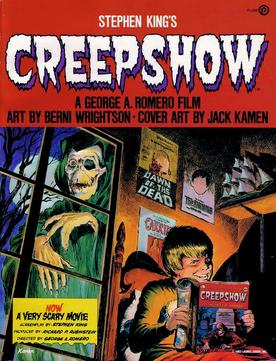
Creepshow is a graphic novella published by Penguin imprint Plume in July 1982, based on the movie Creepshow (also from 1982). The movie, directed by George A. Romero and written by Stephen King, consists of five short films, two of which are based on earlier prose stories by King, while the remaining three were written specifically for the movie.


The book's interior art is by Bernie Wrightson with Michele Wrightson, with a cover by Jack Kamen.

Wednesday, August 5, 2015

The Running Man

The Running Man
by Stephen King (as Richard Bachman)

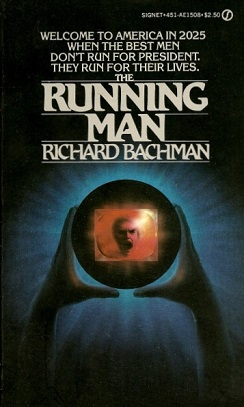
The Running Man is a science fiction novel by Stephen King, first published under the pseudonym Richard Bachman in 1982 as a paperback original. It was collected in 1985 in the omnibus The Bachman Books. The novel is set in a dystopian United States during the year 2025, in which the nation's economy is in ruins and world violence is rising.

The story follows protagonist Ben Richards as he participates in the game show The Running Man in which contestants, allowed to go anywhere in the world, are chased by "Hunters" employed to kill them.

The book has a total of 101 chapters, laid out in a "countdown" format. The first is titled "Minus 100 and Counting ..." with the numbers decreasing, until the last chapter, "Minus 000 and Counting" (or, in some versions, merely "000").

The Running Man was loosely adapted into a film with the same name, which was released five years after the book in 1987. The film starred Arnold Schwarzenegger as Richards. The film was later made into a video game released on several home computers.

Thursday, June 4, 2015

Cujo

Cujo
by Stephen King

Cujo's name was based on the nom de guerre of Willie Wolfe, one of the men responsible for orchestrating Patty Hearst's kidnapping and indoctrination into the Symbionese Liberation Army. Stephen King discusses Cujo in On Writing, referring to it as a novel he "barely remembers writing at all". The book was written during a period when King was drinking heavily. Somewhat wistfully, King goes on to say that he likes the book and that he wishes he could remember enjoying the good parts as he put them down on the page.

The story takes place in the fictional town of Castle Rock, Maine, the setting of numerous King works, and revolves around two local families. The narrative is interspersed with vignettes from the seemingly mundane lives of various other residents. There are no chapter headings, but rather breaks in between passages, which indicate when the narration switches to a different point of view.

The principal characters are the Trenton and the Camber families. The middle-class Trentons have recently moved to Castle Rock from New York, bringing with them their four-year-old son, Tad. Father Vic discovers that his wife Donna has recently concluded an affair. In the midst of this household tension, Vic's fledgling advertising agency is failing, and he is forced to travel out of town, leaving Tad and Donna at home. The blue-collar Cambers are longtime residents; Joe is a shade-tree mechanic who dominates and abuses his wife Charity and their ten-year-old son Brett. Charity wins a $5,000 lottery prize, and uses the proceeds to inveigle Joe into allowing her to take Brett on a trip to visit Charity's sister, Holly, in Connecticut. Joe acquiesces, secretly planning to use the time to take a pleasure trip to Boston.

Cujo, the Cambers' large, good-natured St. Bernard, chases a wild rabbit in the fields around their house and inserts his head in the entrance to a small limestone cave, where a rabid bat bites him on the nose and turns him mad. Soon after Charity and Brett leave town, Cujo attacks and kills their alcoholic neighbor, Gary Pervier. When Joe calls on Gary, Cujo also kills him.

Donna, home alone with Tad, takes their failing Ford Pinto to the Cambers' for repairs. The car breaks down in Camber's dooryard and as Donna attempts to find Joe, Cujo appears and is ready to pounce. She climbs back in the car and Cujo starts to attack. Donna and Tad are trapped in their vehicle, the interior of which becomes increasingly hot in the sun. During one escape attempt, Donna is bitten in the stomach and leg, but manages to survive and escape back into the car. She plans to run for the Cambers' home, but abandons the idea due to her fears that the door will be locked and she will be subsequently killed by Cujo, leaving her son alone.

Vic returns to Castle Rock after several failed attempts to contact Donna and learns from the police that Steve Kemp, the man with whom Donna was having an affair, is suspected of ransacking his home and possibly kidnapping Donna and Tad. In an effort to explore all leads, the state police send Castle Rock Sheriff George Bannerman out to the Cambers' house, but Cujo attacks and kills him. Donna, after witnessing the attack and realizing Tad is in danger of dying of dehydration, battles Cujo and kills him. Vic arrives on the scene with the authorities soon after, but Tad has already died from exposure. Donna is rushed to the hospital, and Cujo's head is removed for a biopsy prior to cremation of his remains.

The novel ends several months later with both the Trenton and Camber families trying to go on with their lives: Donna has completed her treatment for rabies, her marriage with Vic has survived, and Charity gives Brett a new, vaccinated puppy named Willie. A postscript reminds the reader that Cujo was a good dog who always tried to keep his owners happy, but the ravage of rabies drove him to violence.

Tuesday, May 19, 2015

Danse Macabre

Stephen King's Danse Macabre
by Stephen King

Danse Macabre (1981) is a non-fiction book by Stephen King, about horror fiction in print, radio, film and comics, and the influence of contemporary societal fears and anxieties on the genre. It was republished on February 23, 2010 with an additional new essay entitled "What's Scary".

Danse Macabre examines the various influences on King's own writing, and important genre texts of the 19th and 20th centuries. Danse Macabre explores the history of the genre as far back as the Victorian era, but primarily focuses on the 1950s to the 1970s (roughly the era covering King's own life). King peppers his book with informal academic insight, discussing archetypes, important authors, common narrative devices, "the psychology of terror", and his key theory of "Dionysian horror".

Thursday, April 23, 2015

Roadwork

Roadwork
by Stephen King (as Richard Bachman)

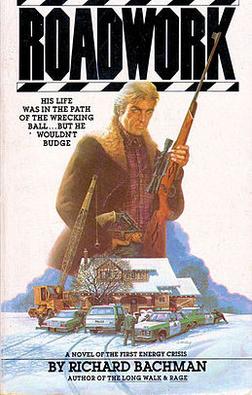
Roadwork is a novel by Stephen King, published in 1981 under the pseudonym Richard Bachman as a paperback original. It was collected in 1985 in the hardcover omnibus The Bachman Books, which is no longer in print. However, three of the four novels in that collection - Roadwork, The Long Walk, and The Running Man - have since been reprinted as standalone titles.

The story takes place in an unnamed Midwestern city in 1973–1974. Grieving over the death of his son and the disintegration of his marriage, a man is driven to mental instability when he learns that both his home and his workplace will be demolished to make way for an extension to an interstate highway.

Friday, February 20, 2015

Firestarter

Firestarter
by Stephen King

Andy and Charlene "Charlie" McGee are a father-daughter pair on the run from a government agency known as The Shop. During his college years, Andy had participated in a Shop experiment dealing with "Lot 6", a drug with hallucinogenic effects similar to LSD. The drug gave his future wife, Victoria Tomlinson, minor telekinetic abilities, and him an autohypnotic mind domination ability he refers to as "the push". They both also developed telepathic abilities. Andy's and Vicky's powers were physiologically limited; in his case, overuse of the push gives him crippling migraine headaches and minute brain hemorrhages, but their daughter Charlie developed a frightening pyrokinetic ability, with the full extent of her power unknown. (Although much later in the novel, Charlie develops an inner conviction that she will eventually be powerful enough to "change the sun" in some way.) The novel begins in medias res with Charlie and Andy on the run from Shop agents in New York City. We learn through a combination of flashbacks and current narration that this is the latest in a series of attempts by the Shop to capture Andy and Charlie following an initial disastrous raid on the McGee family's quiet life in suburban Ohio. After years of Shop surveillance, a botched operation to take Charlie leaves her mother dead; Andy, receiving a psychic flash while having lunch with work colleagues, rushes home to discover his wife murdered and his daughter kidnapped. He then uses his push ability to track the slightly-cold trail of Charlie and the Shop agents, catching up to them at a rest stop on the Interstate. He uses the push to incapacitate the Shop agents, leaving one blind and the other comatose. Charlie and Andy flee and begin a life of running and hiding, using assumed identities. They move several times to avoid discovery before the Shop catches up to them in New York.

Using a combination of the push, Charlie's power, and hitchhiking, the pair escape through Albany, New York and are taken in by a farmer named Irv Manders near the fictional town of Hastings Glen, NY; however, they are tracked down by Shop agents, who attempt to kill Andy and take Charlie at the Manders farm. At Andy's instruction, Charlie unleashes her power, incinerating the entire farm and fending off the agents, killing a few of them. With nowhere else to turn, the pair flee to Vermont and take refuge in a cabin that had once belonged to Andy's grandfather.

With the Manders farm operation disastrously botched, the director of the Shop, Captain James Hollister, or "Cap", calls in a Shop hitman named John Rainbird to capture the fugitives. Rainbird, a Cherokee and Vietnam veteran, is intrigued by Charlie's power and eventually becomes obsessed with her, determined to befriend her and eventually kill her. This time the operation is successful, and both Andy and Charlie are taken by the Shop.

The pair is separated and imprisoned at the Shop headquarters, located in the fictional D.C. suburb of Longmont, Virginia. With his spirit broken, Andy becomes an overweight drug addict and seemingly loses his power, and is eventually deemed useless by the Shop. Charlie, however, defiantly refuses to cooperate with the Shop, and does not demonstrate her power for them. Six months pass until a power failure provides a turning point for the two: Andy, sick with fear and self-pity, somehow regains the push - subconsciously pushing himself to overcome his addiction - and Rainbird, masquerading as a simple janitor, befriends Charlie and gains her trust.

By pretending to still be powerless and addicted, Andy manages to gain crucial information by pushing his psychiatrist. Under Rainbird's guidance, Charlie begins to demonstrate her power, which has grown to fearsome levels. After the suicide of his psychiatrist, Andy is able to meet and push Cap, using him to plan his and Charlie's escape from the facility, as well as finally communicating with Charlie. Rainbird discovers Andy's plan, however, and decides to use it to his advantage.

Andy's plan succeeds, and he and Charlie are reunited for the first time in six months. Rainbird then interrupts the meeting at a barn, planning to kill them both. A crucial distraction is provided by Cap, who is losing his mind from a side effect of being pushed. Andy pushes Rainbird into leaping from the upper level of the barn, breaking his leg. Rainbird then shoots Andy in the neck. Rainbird then fires another shot at Charlie, but she uses her power to melt the bullet in midair and then sets Rainbird and Cap on fire. A mortally wounded Andy then instructs Charlie to take revenge with her power and inform the public, to make sure the government cannot do anything like this ever again, and dies. A grief-stricken and furious Charlie then sets the barn on fire. She exits the barn and people start going after her. She uses her pyrokinesis to kill the employees and blow up their getaway vehicles. People try to flee and some do. Military men are called, but Charlie blows up their vehicles and when they fire at her she melts their bullets. Charlie blows up the building, shooting it sky-high. She leaves the Longmont facility burning, with almost all of its workers dead.

The event is covered up by the government, and released to the papers as a terrorist firebomb attack. The Shop quickly reforms, under new leadership, and begins a manhunt for Charlie, who has returned to the Manders farm. After some deliberation, she comes up with a plan and leaves the Manders', just ahead of Shop operatives, and heads to New York City. She decides on Rolling Stone magazine as an unbiased, honest media source with no ties to the government, and the book ends as she arrives to tell them her story.

Wednesday, February 4, 2015

The Long Walk

The Long Walk
by Stephen King (As Richard Bachman)

The Long Walk is a dystopian novel by Stephen King published under the pseudonym Richard Bachman in 1979 as a paperback original. It was collected in 1985 in the hardcover omnibus The Bachman Books, and has seen several reprints since, as both paperback and hardback. Set in a dystopian present, the plot revolves around the contestants of a grueling walking contest, held annually by a totalitarian version of the United States of America. In 2000, the American Library Association listed The Long Walk as one of the 100 best books for teenage readers published between 1966 and 2000. According to Stephen King, it is the first novel he wrote, begun eight years before his novel Carrie was published in 1974, when he was a freshman at the University of Maine in 1966–1967.

Sunday, January 25, 2015

The Stand

The Stand
by Stephen King

The Stand is a post-apocalyptic horror/fantasy novel by American author Stephen King. It expands upon the scenario of his earlier short story, "Night Surf". The novel was originally published in 1978 and was later re-released in 1990 as The Stand: The Complete & Uncut Edition; King restored some text originally cut for brevity, added and revised sections, changed the setting of the story from 1980 (which in turn was changed to 1984 for the original paperback release in 1980) to 1990, and updated a few pop culture references accordingly. The Stand was nominated for the World Fantasy Award for Best Novel in 1979, and was adapted into both a television miniseries for ABC and a graphic novel published by Marvel Comics. It marks the first appearance of Randall Flagg, King's recurring antagonist, whom King would bring back many times in his later writings.

Thursday, January 1, 2015

Night Shift

Night Shift
by Stephen King

Night Shift is the first collection of short stories by Stephen King, first published in 1978. In 1980, Night Shift received the Balrog Award for Best Collection, and in 1979 it was nominated as best collection for the Locus Award and the World Fantasy Award. Many of King's most famous short stories were included in this collection.

TitleOriginally published in
Jerusalem's LotPreviously unpublished
Graveyard ShiftOctober 1970 issue of Cavalier
Night SurfSpring 1969 issue of Ubris
I Am the DoorwayMarch 1971 issue of Cavalier
The ManglerDecember 1972 issue of Cavalier
The BoogeymanMarch 1973 issue of Cavalier
Gray MatterOctober 1973 issue of Cavalier
BattlegroundSeptember 1972 issue of Cavalier
TrucksJune 1973 issue of Cavalier
Sometimes They Come BackMarch 1974 issue of Cavalier
Strawberry SpringFall 1968 issue of Ubris
The LedgeJuly 1976 issue of Penthouse
The Lawnmower ManMay 1975 issue of Cavalier
Quitters, Inc.Previously unpublished
I Know What You NeedSeptember 1976 issue of Cosmopolitan
Children of the CornMarch 1977 issue of Penthouse
The Last Rung on the LadderPreviously unpublished
The Man Who Loved FlowersAugust 1977 issue of Gallery
One for the RoadMarch/April 1977 issue of Maine
The Woman in the RoomPreviously unpublished

Thursday, November 27, 2014

Rage

Rage
by Stephen King (as Richard Bachman)

Rage (originally titled Getting It On) is the first novel by Stephen King published under the pseudonym Richard Bachman in 1977. It was collected in 1985 in the hardcover omnibus The Bachman Books. The novel describes a school shooting, and has been associated with actual high school shooting incidents in the 1980s and 1990s. As a result, King has allowed the novel to fall out of print.

Charlie Decker, a Maine high school senior, is called to a meeting with his principal over a previous incident in which he struck his chemistry teacher with a pipe wrench, leading to the teacher's hospitalization and Charlie's suspension. For unknown reasons, Charlie subjects the principal to a series of insulting remarks, resulting in his expulsion. Charlie storms out of the office and retrieves a pistol from his locker, then sets the contents of his locker on fire. He then returns to his classroom and fatally shoots his algebra teacher. The fire triggers an alarm, but Charlie forces his classmates to stay in the room, killing another teacher when he enters. As the other students and teachers evacuate the school, police and media arrive at the scene.

Over the following four hours, Charlie toys with various authority figures who attempt to negotiate with him, including the principal, the school psychologist, and the local police chief. Charlie gives them certain commands, threatening to kill students if they do not comply. Charlie also admits to his hostages that he does not know what has compelled him to commit his deeds, believing he will regret them when the situation is over. As his fellow students start identifying with Charlie, he unwittingly turns his class into a sort of psychotherapy group, causing his schoolmates to semi-voluntarily tell embarrassing secrets regarding themselves and each other.

Interspersed throughout are narrative flashbacks to Charlie's troubled childhood, particularly his tumultuous relationship with his abusive father. Several notable incidents include a violent disagreement between two female students, and a police sniper's attempt to shoot Charlie through the heart. However, Charlie survives due to the bullet striking his locker's combination lock, which he had earlier placed in the breast pocket of his shirt.

Charlie finally comes to the realization that only one student is really being held against his will: a seeming "big man on campus" named Ted Jones, who is harboring his own secrets. Ted realizes this and attempts to escape the classroom, but the other students brutally assault him, driving him into a battered catatonic state. At 1:00 p.m., Charlie releases the students, but Ted is unable to move under his own power and remains. When the police chief enters the classroom, the now-unarmed Charlie moves as if to shoot him, attempting suicide by cop. The chief shoots him, but Charlie survives and is found not guilty by reason of insanity, committed to a psychiatric hospital in Augusta until he can answer for his actions.

The final chapters contain an inter-office memo concerning Ted's treatment and prognosis at the hospital where he is now a patient, and a letter from one of Charlie's friends describing assorted developments in the students' lives during the months following this incident. The story ends with Charlie addressing the reader: "That's the end. I have to turn off the light now. Good night."

Tuesday, November 11, 2014

'Salem's Lot

'Salem's Lot
by Stephen King

'Salem's Lot is a 1975 horror fiction novel written by the American author Stephen King. It was his second published novel. The story involves a writer named Ben Mears who returns to the town where he lived as a boy between the ages of 9 through 13 (Jerusalem's Lot, or 'Salem's Lot for short) in Maine to discover that the residents are all becoming vampires. The town would be a location that would be revisited in the short stories "Jerusalem's Lot" and "One for the Road", both from King's 1978 short story collection Night Shift. The novel was nominated for the World Fantasy Award for Best Novel in 1976. In 1987, it was nominated for the Locus Award as the All-Time Best Fantasy Novel.

The title King originally chose for his book was Second Coming, but he later decided on Jerusalem's Lot. King stated the reason being that his wife, novelist Tabitha King, thought the original title sounded too much like a "bad sex story". King's publishers then shortened it to the current title, thinking the author's choice sounded too religious. 'Salem's Lot has been adapted into a television mini-series twice, first in 1979 and then in 2004. It was also adapted by the BBC as a seven part radio play in 1995.

In two separate interviews, King said that of all his books,  '​Salem's Lot was his favorite. In his June 1983 Playboy interview, the interviewer mentioned that because it was his favorite, King was planning a sequel, but he has more recently said on his website that since The Dark Tower series already picked up the story in the novels Wolves of the Calla and Song of Susannah, he felt there was no longer a need for one. In 1987 he told Phil Konstantin in The Highway Patrolman magazine: "In a way it is my favorite story, mostly because of what it says about small towns. They are kind of a dying organism right now. The story seems sort of down home to me. I have a special cold spot in my heart for it!"

The Shining

The Shining
by Stephen King

The Shining is a horror novel by American author Stephen King. Published in 1977, it is King's third published novel and first hardback bestseller, and the success of the book firmly established King as a preeminent author in the horror genre. The setting and characters are influenced by King's personal experiences, including both his visit to The Stanley Hotel in 1974 and his recovery from alcoholism. The novel was followed by a sequel, Doctor Sleep, published in 2013.

The Shining centers on the life of Jack Torrance, an aspiring writer and recovering alcoholic who accepts a position as the off-season caretaker of the historic Overlook Hotel in the Colorado Rockies. His family accompanies him on this job, including his young son Danny, who possesses "the shining," an array of psychic abilities that allow Danny to see the horrific past of the hotel. Soon, after a winter storm leaves them snowbound, the supernatural forces inhabiting the hotel influence Jack's sanity, leaving his wife and son in incredible danger.

The Shining was adapted into a feature film in 1980 by director Stanley Kubrick, with a screenplay co-written with Diane Johnson, which is regarded by some as one of the greatest films of all time. King himself was disappointed with the film, stating it had abandoned several of his book's major themes. The Shining was later adapted into a television mini-series in 1997, closely monitored by King to ensure it followed the book. King wrote the series himself and was reportedly unable to criticize the Kubrick version due to his contract.

Monday, September 22, 2014

Carrie

Carrie
by Stephen King
Second Reading


Carrie is an American epistolary novel and author Stephen King's first published novel, released on April 5, 1974, with an approximate first print-run of 30,000 copies. Set in the then-future year of 1979, it revolves around the eponymous Carrietta N. "Carrie" White, a shy high school girl who uses her newly discovered telekinetic powers to exact revenge on those who torment her — in the process, causing one of the worst local disasters in American history. King has commented that he finds the work to be "raw" and "with a surprising power to hurt and horrify." It is one of the most frequently banned books in United States schools. Much of the book is written in an epistolary structure, using newspaper clippings, magazine articles, letters, and excerpts from books to tell how Carrie destroyed the fictional town of Chamberlain, Maine while exacting revenge on her bullying classmates.

Several adaptations of Carrie have been released, including a 1976 feature film, a 1988 Broadway musical, a 1999 feature film sequel, a 2002 television movie, and a 2013 feature film remake.

The book is dedicated to King's wife Tabitha: "This is for Tabby, who got me into it – and then bailed me out of it."

King's 1979 novel The Dead Zone mentions the book in connection with a fire at another high school prom.

Tuesday, September 9, 2014

The Dead Zone

The Dead Zone
by Stephen King

 The Dead Zone is a horror novel by Stephen King published in 1979. It concerns Johnny Smith, who is injured in an accident and enters a coma for nearly five years. When he emerges, he can see horrifying secrets but cannot identify all the details in his "dead zone", an area of his brain that suffered permanent damage as the result of his accident. Much of the novel is played out against the historical backdrop of the 1970s. The story might be based on self-proclaimed "psychic" Peter Hurkos, who received a head injury in a fall from a ladder, and afterward claimed to be able to know things about people by touching objects that belonged to them, (psychometry). The Dead Zone was nominated for the Locus Award in 1980.

The book is dedicated to King's son, Owen.