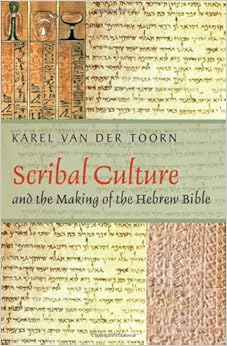
Scribal Culture and the Making of the Hebrew Bible
by Karel van der Toorn
We think of the Hebrew Bible as the Book--and yet it was produced by a largely nonliterate culture in which writing, editing, copying, interpretation, and public reading were the work of a professional elite. The scribes of ancient Israel are indeed the main figures behind the Hebrew Bible, and in this book Karel van der Toorn tells their story for the first time. His book considers the Bible in very specific historical terms, as the output of the scribal workshop of the Second Temple active in the period 500-200 BCE. Drawing comparisons with the scribal practices of ancient Egypt and Mesopotamia, van der Toorn clearly details the methods, the assumptions, and the material means of production that gave rise to biblical texts; then he brings his observations to bear on two important texts, Deuteronomy and Jeremiah.
Traditionally seen as the copycats of antiquity, the scribes emerge here as the literate elite who held the key to the production as well as the transmission of texts. Van der Toorn's account of scribal culture opens a new perspective on the origins of the Hebrew Bible, revealing how the individual books of the Bible and the authors associated with them were products of the social and intellectual world of the scribes. By taking us inside that world, this book yields a new and arresting appreciation of the Hebrew Scriptures.
Showing posts with label Near East. Show all posts
Sunday, October 25, 2015
In the Wake of the Goddesses
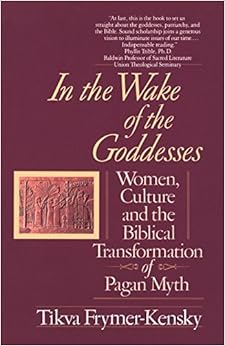
In the Wake of the Goddesses: Women, Culture and the Biblical Transformation of Pagan Myth
by Tivka Frymer-Kensky
The current return to spiritual values has spawned a surge of interest in the ancient goddess-based religions as a remedy to a long tradition of misogyny in the Western religions.
But how accurate are these current representations of the goddess in polytheism? And did Judeo-Christian religion really turn its back on women? These are some of the questions that scholar and feminist Tivka Frymer-Kensky sets out to answer in this iconoclastic study of gender in religions past and present. Her argument, illustrated with fascinating accounts of myth and ritual dating back to the early days of Sumer, Assyria, and Greece, is that although polytheism did accord females an important role, the strict division between male and female actually served to keep women in a subordinate position. The goddesses were progressively "ghettoized": their sphere was eventually relegated to home and hearth, while male gods took over as patrons of wisdom and learning. This dualism was displaced by the Bible, which embraced a surprisingly egalitarian view of human nature in which women were not considered to be inherently inferior.
In a provocative work of biblical scholarship on gender and sexuality, Frymer-Kensky shows that the ideal of monotheism may offer far more to us today than a return to the gender-based worldview of the goddess religions.
by Tivka Frymer-Kensky
The current return to spiritual values has spawned a surge of interest in the ancient goddess-based religions as a remedy to a long tradition of misogyny in the Western religions.
But how accurate are these current representations of the goddess in polytheism? And did Judeo-Christian religion really turn its back on women? These are some of the questions that scholar and feminist Tivka Frymer-Kensky sets out to answer in this iconoclastic study of gender in religions past and present. Her argument, illustrated with fascinating accounts of myth and ritual dating back to the early days of Sumer, Assyria, and Greece, is that although polytheism did accord females an important role, the strict division between male and female actually served to keep women in a subordinate position. The goddesses were progressively "ghettoized": their sphere was eventually relegated to home and hearth, while male gods took over as patrons of wisdom and learning. This dualism was displaced by the Bible, which embraced a surprisingly egalitarian view of human nature in which women were not considered to be inherently inferior.
In a provocative work of biblical scholarship on gender and sexuality, Frymer-Kensky shows that the ideal of monotheism may offer far more to us today than a return to the gender-based worldview of the goddess religions.
Subscribe to:
Posts (Atom)